 Like all hobbyists, radio amateurs are completely consumed by their pursuit. So much so that their friends and relatives wonder whether they are sane.
They are cooped up in their attics, calling people halfway around the world just so they can log the call and add a notch to their list. They are called ham radio amateurs and use frequencies in the short wave range of the radio spectrum which allows transmissions to bounce off the ionosphere to reach the other side of the planet.
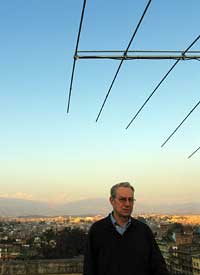
The history of ham radio in Nepal is long and illustrious, and that is mainly due to the contribution of one man: Fr Marshal Moran the American Jesuit priest who started St Xaviers School in Godavari in 1951. At a time before Internet, before international phone calls, even before teletype, Fr Moran could reach any part of the world at the push of a microphone button.
Ham rules don't allow operators to use their equipment for commercial purposes but hobbyists have been a big help during times of crisis or momentous events. Fr Moran became the point man for early mountaineering expeditions, including the first ascent of Mt Everest in 1953.
Famous ham operators have included King Hussain of Jordan and King Juan Carlos of Spain. Ham operators in Japan have provided invaluable services during major earthquakes, in New York during 9/11 and during last week's tsunami hobbyists were the link to the disaster-affected areas at a time when all other communications failed. (See box).
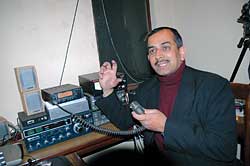
After Fr Moran died in 1992, the torch was passed to a new generation of Nepali ham enthusiasts. Satish Kharel is one of five licensed Nepali Ham radio operators. Kharel is a lawyer but was always interested in electronics and even before he knew about ham radio he was tinkering with his shortwave set trying to tune into distant broadcasts.
Kharel had to sit for an exam held by the Ministry of Communicaitons to get his radio amateur license in 1993 and since then he has been flying the Nepali flag, as it were, on the radio waves. He built his first short wave radio through which he transmitted using Morse code, and it cost him around Rs 800. Today, Kharel has equipment worth approximately Rs 20 lakh though he is unable to install and use them all.
"Ham radio as a hobby is not very expensive," explains Kharel, "and you can make it as sophisticated as you want. But the most expensive transceiver doesn't compare to the pleasure of making your own radio."
His legal work allows Kharel to use his radio only on weekends and during holidays when he is able to contact a lot of people. During Dasain alone, he logged 7,000 contacts all over the world in 10 days. He says, "You have to be able to devote three to four hours once you get connected. There are so few Nepali users that everyone wants to talk to you." Kharel has totalled 50,000 radio contacts since 1993.
Kharel's radio has also been of use to various people needing help during the Kobe and Gujarat earthquakes. His dream is to start a club station where licensed users can come and use the equipment. He feels that people have been unable to use ham radio due to lack of equipment and the fact that the Ministry hasn't held the license exam since 1998.
Himalayan hams