America’s clandestine mining of electronic data sends some important messages about its culture: that it is justifiable to encroach upon the privacy of others, that it is morally sustainable to suspect and spy on friends on the suspicion they could work against your interests, that hypocrisy is an acceptable code of behavior, and that the powerful are tacitly permitted a leeway with laws and norms they had themselves helped formulate.
Indeed, the international drama involving PRISM whistleblower, Edward Snowden, and the United States is a contest over the principles of morality underlying the organisation of our society.
This is what goaded Snowden to leak information on the eavesdropping. He was an individual rebel raging against an arrogant, implacable state. Rebels seek to restore to their societies the moral values set aside in the wielding of power, or reset the moral compass in the present that is different from the past.
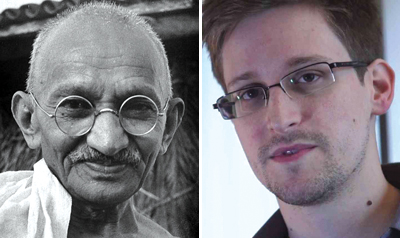
The last decade, particularly, seems to have spawned a rash of rebels in different countries and cultural contexts: WikiLeaks founder Julian Assange and Bradley Manning; the Tunisian fruit-seller, Tarek al-Tayeb Mohamed Bouazizi, who set himself on fire and triggered an upsurge against authoritarian governments in West Asia; the Standing Man (Erdem Gunduz) of Istanbul; Anna Hutsol, the Ukrainian who bared her breasts in 2008 to register her opposition to sex tourism, sparking off the FEMEN movement; and Anna Hazare and Arvind Kejriwal, who have railed against the culture of corruption in India.
However, rebellious attempts to redefine or reset society’s morality button are not of recent vintage. For instance, recall the refusal of Gandhi in 1893 to disembark from the first-class train coach, reserved exclusively for whites in South Africa. Tossed out on the platform at Pietermaritzburg, the humiliating experience inspired Gandhi to wage a battle against racial discrimination.
Though it took nearly a century to dismantle the apartheid system, there are nevertheless three lessons for us to draw from it. One, rebellion necessarily entails a transgression of laws. Two, it is inevitably directed against the state which is the principal designer of society in modern times. Three, morality underlying constitutional framework requires both constant vigilance and periodic rethinking. These two goals the rebel through his or her precipitous actions serves.