
There is probably no country in the world where everything shuts down for two weeks, and half the population of the capital city goes home to the villages. China’s Golden Week comes close, but only Nepalis do holidays with such enthusiasm and inaction.
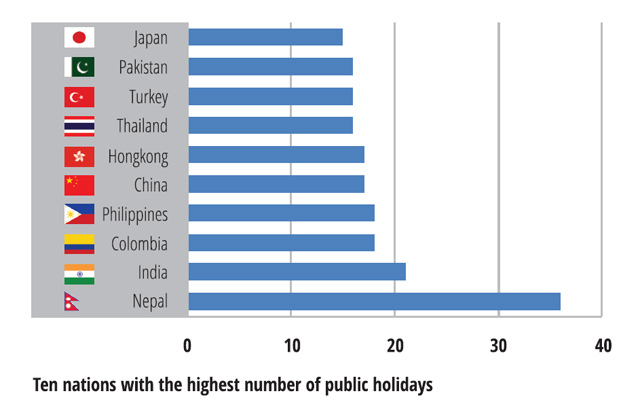
Generally, people get almost eight days off during Dasain, but this year the main days of Ghatastapana, Phulpati and Kojagrat fall on Saturdays so most Nepalis are regretting the loss of three days from the long holiday. Soon after Dasain comes Tihar, another four days off, and then in the Tarai there is the Chhat festival. More holidays. This year’s 2073 calendar indicates that there are 36 public holidays. Add that to the impromptu days off that the government declares from time to time to mark important events, and it is clear why Nepal tops the list of countries for the most number of public holidays in the year.
Some would argue that this is unfair because Nepal only has one-day weekends, and therefore the national holidays compensate for it. True, if Sundays are counted most other countries would have 48 more days off in a year.
Public holidays, national holidays, or legal holidays are terms meaning nothing more than a day in a year set aside as non-working days decreed by the government. There are many countries that enjoy the privilege of having a large number of public holidays generally marking the anniversary of an important historical event, religious celebration, or a holiday falling on a certain day of the week or following some calendar system, such as the Chinese or Lunar Calendar.
Nepal tops the list of countries with the most public holidays (see graph) with 36 days a year, followed by India with 21 public holidays, Colombia and the Philippines with 18 days, China and Hong Kong 17 days, Thailand, Turkey, and Pakistan with 16 days. Japan, Argentina, and Sweden each have 15 holidays per year.