
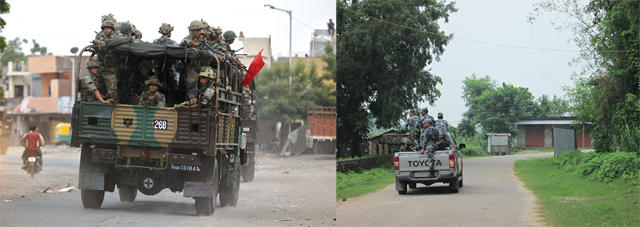
TALE OF TWO RIOTS: The Indian Army patrols the streets of Ahmedabad (left) after deadly anti-reservation riots last week which had parallels with protests in Nepal's Kailali district against provincial boundaries in the new constitution, which left nine people dead. Pic credit: DNA (left) and Bachu BK (right)
The same week that Nepal deployed the army to contain ethnic unrest in Kailali, India had to clamp down on a parallel outburst of violent protests in Gujarat.
Nine policemen were killed, the army was on the streets in Kailali. In Gujarat, ten people including a policeman died and the Indian Army was sent out to quell caste riots. In Nepal the protests were triggered by Tharu community’s unhappiness over provincial demarcation in the new constitution, while in India the agitation was spearheaded by the Patel community demanding a share of government jobs and college seats reserved for Dalits and what they call ‘Other Backward Communities’ (OBC).
On social networking sites, some Nepalis drew comparisons between the Kailali killings and the Gujarat violence because they were both about communities which felt aggrieved by state policy. But there may be more than meets the eye in comparing India’s Patel movement and growing discontent over reservation policy among Nepal’s Bahuns and Chhetris.
The Patel movement could be an indication of a future anti-reservation movement in Nepal, too, where Bahuns and Chhetris are arguing that caste-based reservation policy is not justified because sections of their community are poorer than Janjatis or Dalits. If an activist like Hardik Patel, the 22-year-old leader of the Patel movement in Gujarat, can succeed in uniting anti-reservation youths, there is the possibility that Nepal’s own quota policy too could be diluted. We can be smarter about it by reforming our existing reservation policy, which is flawed and fails to uplift the genuinely marginalised.
In the end, it boils down to making a distinction between caste and class. Although social inequities in Nepal have caste and ethnic characteristics, it is becoming and will continue to be more class-based. Nepal’s reservation policy was introduced not only too late but also in haste. After the 2006 Democracy Movement, which was a culmination of years of struggle for an inclusive society, Nepal finally amended the Civil Service Act-1993 to reserve 45 per cent of government job quotas for Dalit, Madhesi, Janajati and women.
But that law did not differentiate between privileged Janjatis and under-privileged Janjatis, or privileged Madhesis and under-privileged Madhesis. As a result, well-off Janjatis, Madhesi, Dalits and women are now able to grab all quotas reserved for the marginalised, breeding resentment among Bahuns and Chhetris who may lag behind economically.