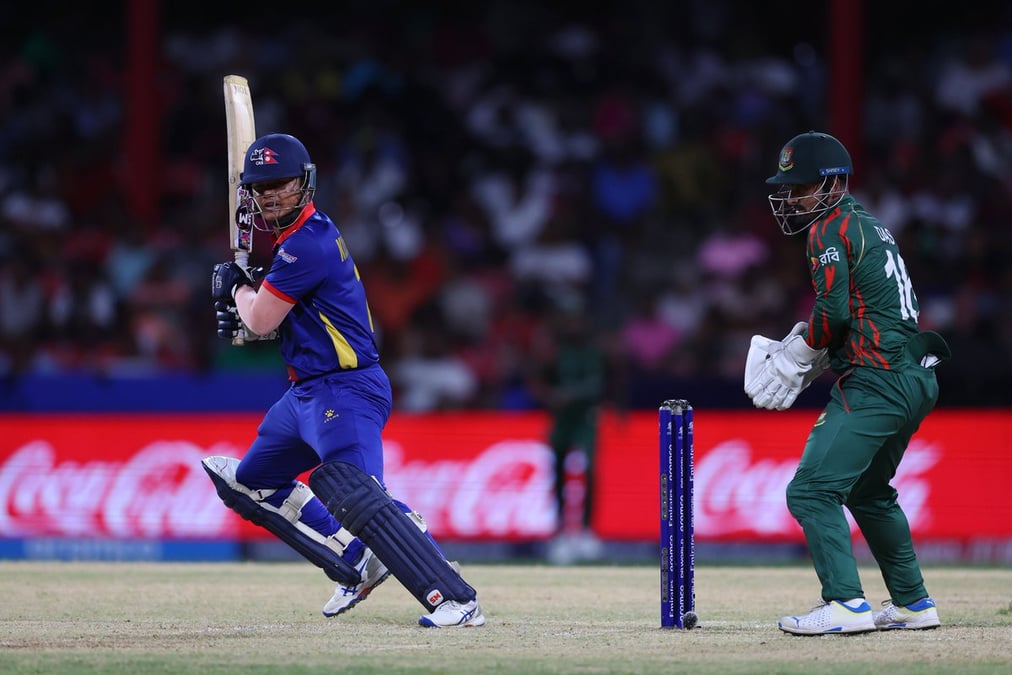
On paper, Nepal had a terrible time at the ongoing ICC T20 World Cup in the Americas. Three defeats in games against The Netherlands, South Africa and Bangladesh. One game washed out against Sri Lanka. Dumped out of the group stage, with a grand total of just one point.
Yet, Nepal overperformed. None of the three defeats were remotely embarrassing. In fact, in the latest match against Bangladesh, Nepal had a fighting chance right until the last overs. If only a few things gone its way, the Rhinos would have beaten both The Netherlands and South Africa.
Frenzied Nepali fans packed stadiums in Dallas and St Vincent and the Grenadines. The audience was overwhelmingly blue and red, dhaka topis and flags aplenty. The diaspora had flown in from New Hampshire, Texas, Indiana, and the UK and were the most effective cheerleaders of any of the fans.
“Even the locals and neutrals wanted Nepal to win,” says Shrochis Karki, who flew from Oxford to watch the matches against South Africa and Bangladesh.
“You could feel the emotional connection between the fans and the team. There was so much joy at every boundary,” describes BBC Nepali sports correspondent Niranjan Rajbanshi who is covering the games. “Ultimately, the difference in experience between the established test-playing nations and Nepal as an associate country led to the defeats.”

The tournament seemed to generally favour bowlers and part of the reason lies in the pitches. The US is not much of a cricketing country and despite imported Australian experts, its turfs were not the most conducive for batting.
“Nepal’s strength has always been its bowling. This is the strongest possible group of Nepali batsmen and they did as well as they could. They will get better at these situations as they play more against good teams,” explains Rajbanshi.
Nepal had a much better fielding performance against Bangladesh on Monday, with four catches and a runout. Nepal restricted Bangladesh to 106, and was looking at a tough but doable chase at the end of the sixteenth — 30 off the last four at 7.5 runs an over.
However, tight death bowling from Bangladesh speedster Mustafizur Rahman who went for one run and two wickets in overs 17 and 19 meant that Nepal was all out for 85. Kushal Malla scored 27. Sompal Kami, Airee, Paudel and Sandeep Lamichhane picked up two wickets apiece.
“Dipendra Singh Airee’s game is three-dimensional. He can win the game with the bat or the ball, or in the field,” observed Karki. Airee took six wickets across the three games and today he scored 25.
Despite the results, Nepal has been The Story of the Tournament. The team showed it is just about ready to play in the Tests - the tradition-soaked five-day epics that are considered the summit of the sport.
“To become a test-playing nation, you can’t just have talented players,” pointed out Rajbanshi. “There needs to be extensive domestic cricket infrastructure, government support, and stadiums that can host test matches.”
There is progress: stadiums are being built in Kathmandu, Chitwan, Rupandehi and Morang. And Nepal is already planning to tour Afghanistan once the T20 World Cup is over.