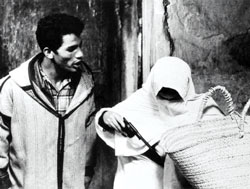
Cineastes regularly talk of Gillo Pontecorvo's The Battle of Algiers with a
reverence that is reserved only for the rarest of films. It is remarkable how
one as unsettlingly political as this pulled off such a coup in the world of art
and culture that is usually so tenaciously apolitical.
Then again, it was never enough just to describe Algiers as a film that
epitomised a phase in global history where mass movements and collective action
sought to change the shape of the old colonial world. Released in 1966, Algiers
came at a moment when the concept of culture itself was gaining new meanings.
Culture, in the 1960s, no longer embodied the sense of high-and-mighty
refinement. It had migrated from the patrician sanctuaries to the domain of
everyday life and lower-class dissent. The success of Algiers in a way came to
represent this shift.
Many artists and filmmakers in the period after the Second World War had
turned to the disenfranchised for creative inspiration. Italian director
Pontecorvo and co-writer Franco Solinas turned to the burgeoning anti-colonial
movement. The film takes as its subject a particularly violent episode in
Algeria's revolutionary war against French colonialism. Desperate for
independence, Algerian rebels have taken to terrorism. Snipers shoot and women
plant bombs in trendy locales visited by French settlers. The French army
responds mercilessly and indiscriminately, hunting down every member of the
insurgent cells.
Algiers is an extraordinary feat in neo-realism, obliterating the distance
between reality and representation. Like the films of other neo-realists like
Roberto Rossellini and Vittorio De Sica, the film's use of non-professional
actors and real locations in the Casbah is remarkable enough. But the
documentary-like veracity it achieves through its use of masses of people and a
newsreel style is uniquely spectacular.
Moreover, no other film captures as authentically and reasonably the ethical
contradictions of human existence (and the colonial mindsets). On one side is
Ali La Pointe (Haggiag), the rebel leader, deserving our utmost empathy yet
whose modus operandi is downright insufferable. On the other stands Colonel
Mathieu (Martin), a menacing disciplinarian whose logic and grasp of the
situation is uncomfortably impressive.
More than anything else, though, Algiers is stunning for its prescience and
earth-shattering social significance. The world may have changed a lot since the
Algerian War. But somehow in that struggle, as depicted in this film, are
trapped all the predicaments of modernity - nationalism, inequality,
imperialism, fundamentalism, and terrorism. American officials would not
otherwise be screening the film at the Pentagon.
Watching Algiers is a riveting experience that irrevocably binds its viewers
to the power of cinema and inducts them into newer world-views. Catch it next
Friday at the Alliance Francaise, Tripureshwor. 4241163
Director: Gillo Pontecorvo.
Cast: Brahin Haggiag, Jean
Martin, Saadi Yacef.
1966. 117 min. In French and Arabic, with English
subtitles.