
When Disney bought all of the rights to the Star Wars intellectual property in 2012 no one quite knew what was going to happen, aside from a blinding clarity regarding infinite franchises based on beloved characters that have endured through decades. Unimpeded use of all this precious material, a feat, and a possible folly, was accomplished by paying a jaw-dropping $4 billion to Lucasfilm, an entity that had been solely owned by the creator of the Star Wars franchise, George Lucas himself.
Since then, Star Wars has been resuscitated successfully with The Force Awakens (2012), the story of how Vader became, well, Darth Vader, a smash hit that was directed by J.J. Abrams, the go-to guy for all sci-fi doctoring. Now, with the added success of Rogue One the aforementioned acquisition looks more than ready to pay for itself.
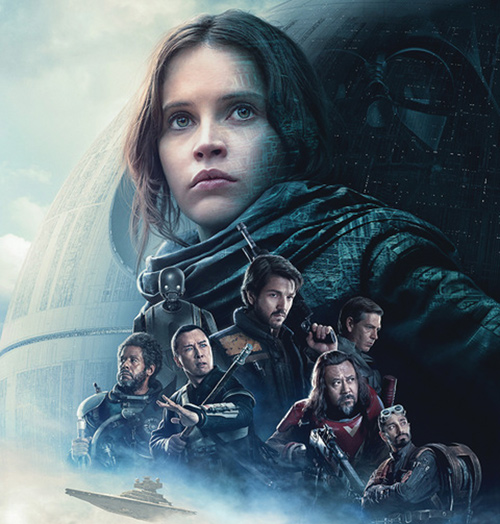
Rogue One, a stand-alone film with no intended sequels, centres around Jyn Erso, played against her usual type by the lovely Felicity Jones, a loner who is a crucial piece in the ongoing fight between the Empire and the Rebel forces. Jyn’s story follows a classic Star Wars trope, she is strong and feisty but traumatised by the loss of her mother and the separation from her father Galen Erso (played by the wonderful Mads Mikkelson), a talented engineer who seems to have turned away from the Force, choosing instead to build the Death Star. Running wild after she has been reluctantly forsaken by the rebel leader Saw Gerrera (Forrest Whittaker), who saved her from her desert planet (ring a bell?), Jyn is the diamond in the rough, a female iteration of Han Solo or James T. Kirk, but fortunately without too much of the irritating, initial abandonment syndrome shenanigans displayed by the aforementioned archetypal space heroes.