
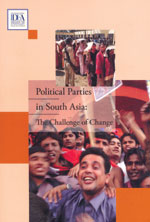
 Political Parties in South Asia: The Challenge of Change, KC Suri et al, International IDEA, 2007, Stockholm, 144pp, price not mentioned |
The worst victims of every experiment in controlled democracy have been political parties. They have failed to emerge as principal actors of political process.
With the exception of India, which was closer to the Soviet Union than to the USA, malfunctioning parties are common features of most countries going through the democratisation process.
Some of the clearest illustrations of this come from the experiments in limited democracy carried out during the Cold War and the 1960s in particular. In Indonesia, this hybrid regime was herded by a military strongman-turned-civilian ruler and called "guided democracy". In Pakistan, General Ayub Khan called his dictatorship "basic democracy" and parties are today little more than platforms for ambitious individuals. In Bangladesh, political enterprises are inherited like family firms. Political parties in Nepal, where King Mahendra spoke of "indigenous democracy" suited to the "air, water, and soil" of Nepal, can be seen as a microcosm of the South Asian scene.
International IDEA's new publication, Political Parties in South Asia: The Challenge of Change is a study report of political parties of Bangladesh, India, Nepal, Pakistan, and Sri Lanka. Its seven chapters discuss the context, content, circumstances, conditions, and course of the region's major political parties.
Although most donors realise by now that poverty alleviation requires democratic governance-which in turn cannot occur without vibrant, dynamic political parties-party building continues to be uncharted territory. There is no formula, no replicable method for creating effective political platforms.