
 LILA BALLAV GHIMIRE/KANTIPUR |
The Maoist party is not just the biggest party, it is also the prime mover of the peace process. That is why it is important for our party to be part of a national government, so the people will be convinced that the constitution will be possible on May 28, or soon after. Last year, a lot of people were trying to push us back into the jungle. They are still trying to do this. But we are not going back to fighting a guerrilla war. The peace process came about after a lot of blood was shed by the children of Nepalis, we are not going to abandon our peace efforts. But some people are still trying to dissolve the CA, others want to encircle the cantonments. There are those who want to roll back republicanism and secularism and who are against progress and transformation. We will not be able to defeat these forces unless we have a consensus government. Unfortunately the present state of affairs is leading to revisionism, backsliding, and regression. My feeling is that after coming into this historic constitution-making process and after ushering in a republic, neither the guerrillas in the cantonments nor the Nepal Army want to return to conflict. If we remember this, we can reach an agreement on the constitution and we will. There is no alternative. For this a national government isn't a condition, it is indispensable. The Nepali people will not tolerate any conspiracy to derail the peace process.
Excerpted from a speech at the National Association of Professors.
Editorial in Rajdhani, 20 April
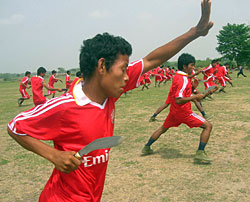
Prime Minister Madhav Nepal may not admit it publicly but he has reason to be distrustful of Maoist promises, and the people understand this. The nationwide mobilisation by the Maoists of their cadre for military training is being taken seriously by a section of the international community. However, there are agencies that have closed their eyes to such Maoist behaviour while trying to extend their role. The end result is the possibility of a militant mindset driving extremism to dominate the country. In this struggle, those who will suffer are the pro-democratic forces that believe in pluralism and nationalism. It is because the UML and NC have been unable to challenge the agenda of the Maoists and other extremist groups that the country is now in the grip of ethnic, communal and territorial fragmentation. Unless these two parties put up a solid, united front to deal with the Maoist threat of 'state capture' they will also themselves go down in history as parties that couldn't stop the extinction of democracy in Nepal.