Since the 1950’s Nepalis have dreamt of developing the country’s enormous hydropower potential for industrialisation and export to India.
Nepal chose to avoid the path followed by Bhutan of handing over design, financing, and construction of hydropower to India. Policy makers tried instead to maintain control by soliciting assistance from bilateral donors and multilateral development banks to finance power projects using grants and concessionary loans.
But as the size of investments increased, it resulted in greater reliance on international aid and technical assistance. Projects were typically designed by global consultants and constructed by international contractors through competitive bidding and once completed were handed over by the government to Nepal Electricity Authority (NEA) to own and operate.
By the 1980’s a flaw in this approach had become clear: it had created another kind of dependence and loss of control. The electricity produced was expensive since these projects, although funded through grants or loans on concessionary terms, were transferred to NEA’s books at the full cost of the assets which needed to produce returns.
A more debilitating effect was that almost no technical or financing capacity was transferred to NEA for the next power plant without more aid. As international assistance was always in short supply, Nepal’s hydropower development proceeded slowly and the electrification rate lagged at 15% in 2000. There was little prospect for exporting power since it was so expensive, and there was chronic domestic shortage.
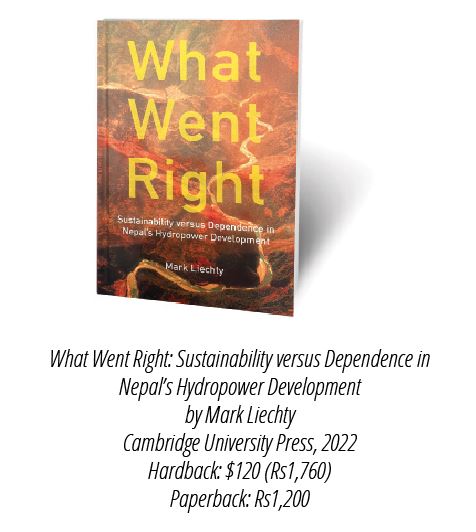
In his book What Went Right: Sustainability versus Dependence in Nepal’s Hydropower Development, Mark Liechty who is professor of anthropology and history at the University of Illinois at Chicago skillfully narrates the inspirational story of Nepal’s alternative hydropower development.
At centre are Norwegian missionary Odd Hoftun and his colleagues, who over the course of five decades, did not just build power projects but laid the foundation for a vibrant domestic energy sector with thousands of competent Nepali engineers and technicians, hundreds of independent power producers, and dozens of construction companies, equipment manufacturers and engineering consultancy firms.
This book should be required reading for development practitioners and aid agencies interested in critically examining how to get the best returns from international development assistance.
Liechty recalls the strategy to develop hydropower that was quietly taking shape in Butwal in parallel with the Kathmandu-centeric public sector-led model funded by the county’s major donors. The ‘Butwal Model’ emphasised vocational training and learning opportunities in the manufacture of components and by building actual power plants.
Training of skilled manpower was born out of necessity in a region of the country with no industrial base, very few schools, and certainly none that imparted specialised technical skills required for hydropower development. The second element was the formation of local private companies to design, construct, and operate hydropower projects initially to electrify the training institute and supply nearby urban and rural communities, and eventually to feed surplus power to the NEA grid as the Butwal companies constructed larger power plants.
As the companies grew in size and sophistication, they attracted increasing numbers of Nepali engineers, trained at universities and technical colleges in India and Kathmandu, who sought more a challenging professional work environment than at NEA. International experts from over a dozen countries, worked as volunteers alongside Nepalis training technicians, managers and entrepreneurs on the job.
The training was as important as the construction of hydropower plants. The power projects were also initially funded with international aid, mainly from the Norwegians, but it was sympathetic to the vision of using project design and construction as an opportunity to build lasting human capacity in Nepal.
Hoftun came to Nepal as a Norwegian Christian missionary and was primarily responsible for conceiving and initiating the Butwal hydropower development model. His development philosophy grew organically as a series of practical steps required to meet needs, rather than as a fully thought through answer from the beginning. Hoftun died aged 95 earlier this year.
Hoftun believed in frugal use of resources, a framework of moral business practices, and a belief that private companies working under ethical principles were the most efficient vehicles for Nepal’s economic development. That philosophy resonated with Hoftun’s Nepali colleagues such as Balaram Pradhan, who may not have shared his religious faith, but found strong overlap with their own commitment to national development.