
America is either a melting pot or a salad bowl, depending on who is talking, but in The Billionaire’s Apprentice it is mainly populated by Indians. Indian Indians, that is, not native Americans. The crooks in this true story are of South Asian descent (Rajaratnam, king of kings, and Rajat Gupta, his apprentice), and the other important players (Preetinder S Bharara and Sanjay Wadhwa) from the US federal government who painstakingly bring them both to justice.
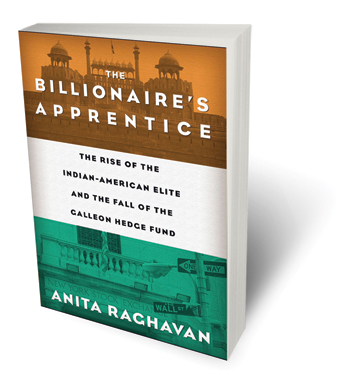
Author Anita Raghavan is also of Indian descent, used to work for the Wall Street Journal, and has done a magnificent job of using tapped phone transcripts that US courts allowed to be used for the first time in a insider trading scandal for her book.
Rajaratnam, a mathematics wizard originally from Sri Lanka, founded Galleon, a hedge fund company. He has nurtured his talent well in the dog-eat-dog world of Wall Street and has been duly rewarded. He is a billionaire, but his addiction to making more money insatiable. Rajat Gupta is a handsome Indian businessman-philanthropist, who is a millionaire but aspires to be a billionaire by becoming friends with Rajaratnam.
Harvard-educated Rajat Gupta, one of the most accomplished Indian-Americans, sits on the board of many important financial organisations such as McKinsey, Goldman Sachs, and American Airlines. After a board meeting, he would secretly phone his friend Rajaratnam and illegally share juicy financial nuggets prompting Rajaratnam to sell or buy certain stocks and make big bucks instantly.
The exquisite irony is that neither Rajaratnam nor his apprentice, Rajat Gupta, needed to be cheats as they were already rich and well respected in American society, from its President (Gupta was a guest at the White House at least on one occasion) to ordinary Americans who marvel at these elite South Asians for making it into the American system.
Rajaratnam comes across as a smart Bollywood gangster type in appearance and actions. The gentle character of Rajat Gupta thus contrasts sharply with Rajaratnam’s rowdiness. The two characters represent the people and the generations of South Asians who were “twice blessed”: to be born after Indian Independence in 1947 which allowed social advancement and world travel, and the civil rights act in the US in 1965 which did away with limited annual immigration of only 100 Indians to America. More were welcome based on their skills.
For many Indians like Rajat Gupta who had attended the fiercely-competitive Indian Institute of Technology (IIT) and were ready to take on the world, America with its changed immigration policy clearly became a beacon of hope in the Indian darkness. Throughout his trial Gupta continues to deny any wrongdoing. It appears he has rationalised his actions. Whiffs of pervasive corruption from South Asia have clearly been transported to greedy, welcoming Wall Street.
To a South Asian audience this book also feels like a cautionary tale from the Hindu Purans of prodigious talent, hard work and immense wealth all turning in to ashes.
Buddha Basnyat