

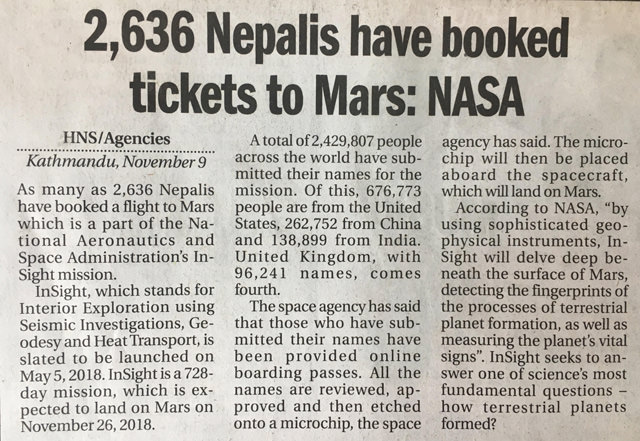
According to a recent news report, 2,636 Nepalis have registered with the US National Aeronautics and Space Administration (NASA) for a flight to Mars under its InSight mission that will blast off in May next year on a 728-day trip. Based on proportion of a country’s population, Nepalis come out right on top in terms of our enthusiasm for inter-planetary travel. We understand from NASA sources that some of the lucky ones already have boarding passes. (Everything up to here is the tooth, the whole tooth and nothing but the tooth, and if you don’t believe me I have scanned the said news item, below).
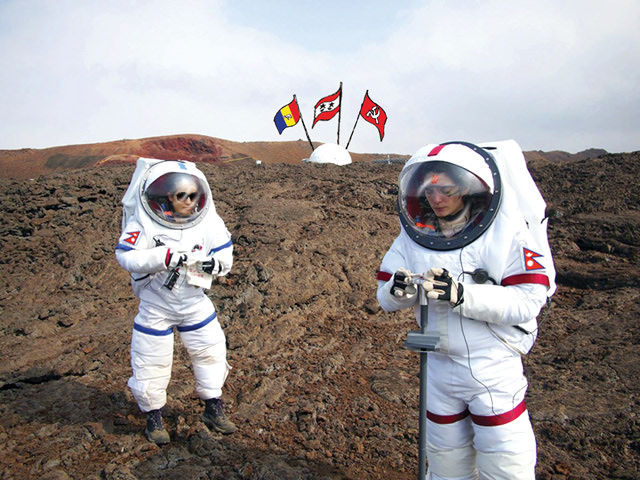
Nepalis have been migrating to neighbouring countries for centuries, and there isn’t a place in the world today where there aren’t people from Nepal. Now that there isn’t anywhere else to go on Earth, Nepalis seem keen to travel to the far reaches of the solar sysem. Not surprisingly, more women are interested in Mars because they read somewhere that men are from there. Already, some of them are practicing walking around in an alien environment, and have chosen the cement factory quarry in Chobhar. With its rocky landscape and toxic air quality it most accurately resembles the terrain, as well as the atmosphere, on the Maritan surface.
Since they are in the habit of grabbing every junket that comes their way, some politicians and civil servants have also signed up for Mars, and the space cadets from Singha Darbar have been enquiring about their TA-DA. Which is all well and good because as a country that has never been under any foreign yolk in recent human history, we can’t afford to be left behind in the space race to colonise the Near Planets.
Being a very adaptable people, Nepalis will feel perfectly at home on the surface of Mars since the texture and thickness of the dust will be so similar to the dust at the Satdobato Intersection. Although there are signs that Mars once had water, there isn’t any left – just like in Kathmandu Valley. The Martian atmosphere is made up of 96% carbon dioxide and carbon monoxide, with very little oxygen, and most residents of Kathmandu are already breathing that.