
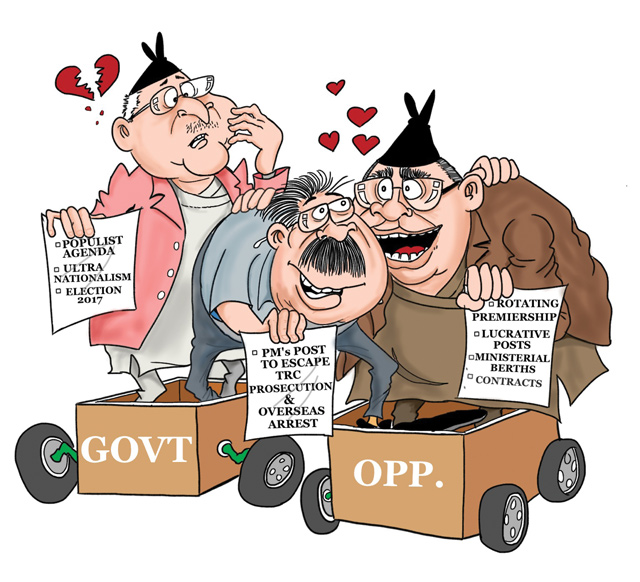
Two political leaders who were once ready to kill each other joined hands this week to form a new government.
Maoist leader Pushpa Kamal Dahal suddenly switched sides, abandoning Prime Minister KP Oli for Sher Bahadur Deuba of the Nepali Congress. They agreed to take turns to be prime minister for the next 18 months.
The new-found friendship between these former foes could prove costly. The first casualty will be the Constitution that all three leaders pushed through last year.
Deuba was prime minister when the Maoists went to war in February 1996. In 2002, when he was prime minister for the second time, Deuba put a price on Dahal’s head. Dahal in turn ordered his guerrillas to kill Deuba, and he narrowly escaped a Maoist attack in Kailali.
Politics makes for strange bedfellows, but who would have predicted that Dahal and Deuba would one day be best buddies? Oli foiled an earlier attempt to unseat him in May by charming Dahal out of an alliance with Deuba. This time the Maoist-NC ties seem stronger, and the deal allows Dahal to be prime minister first, to be replaced by Deuba after local elections in December and until provincial and parliamentary polls.
The Maoists registered a no-confidence motion against the government on Wednesday, but Oli has refused to step down, preparing instead to face a vote in Parliament this weekend. But the arithmetic is against him. Madhesi and other fringe parties are backing the NC-Maoists, so Dahal is on course to be the next prime minister.
Seven years after a humiliating resignation following his failure to oust the Army chief, Dahal may be Nepal’s 24th prime minister in 26 years. But he will be looking over his shoulder warily at Deuba and Oli.
Even less confidence
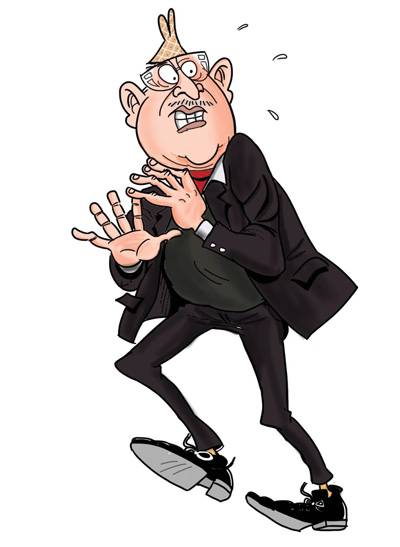
Hours after CPN (Maoist-Centre) Chair Pushpa Kamal Dahal and Nepali Congress (NC) President Sher Bahadur Deuba registered a no-confidence motion against Prime Minister KP Oli’s government in Parliament on Wednesday, NC legislator Amresh Kumar Singh warned in an interview that federalism will not work in Nepal.
Coming from a fervent proponent of ethnicity-based federalism in the new Constitution, his comments on BBC Nepali Service on Wednesday night set off a firestorm. Singh is an obscure NC MP who wields mysterious clout in Nepal’s politics, and is given to outlandish rhetoric.
When the NC agreed with the UML, the Maoists and the MJF (D) to fast-track the new Constitution after last year’s earthquake without the Madhesi parties on board, Singh nearly revolted. He allied with Madhesi leaders to foil the Constitution-drafting process led by his own party, and was even in the group that went down to Kailali to incite the Tharus to rise up in August 2015. Later, eight policemen and a child were lynched in protests. Demonstrations swept across the Tarai and lasted six months, leading to a border blockade supported by India. Nearly 50 more persons were killed in police action against the protests.