
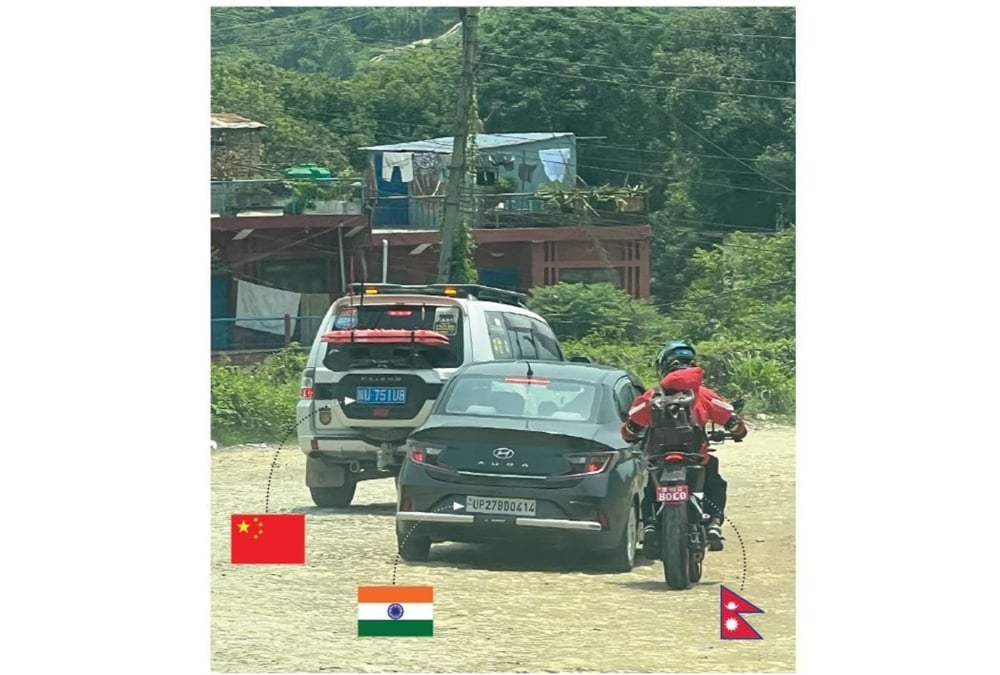
This photograph of Chinese and Indian registered vehicles alongside a Nepali motorcyclist this week on a bumpy stretch of the highway named after Nepal's founding king Prithvi Narayan Shah is symbolic of the state of the country's foreign policy.
In a significant departure from his famous unwillingness to greet international envoys, Prime Minister Balendra Shah on Tuesday met collectively with a delegation of ambassadors and diplomats from the EU and other countries.
Given his reclusiveness, the guests were made to feel honoured and lucky. He had earlier refused to meet US president’s special emissary in charge of South and Central Asia Sergio Gor, as well as Indian Foreign Secretary Vikram Misri and British Minister for the Indo-Pacific Seema Malhotra.
While some diplomats privately said they were underwhelmed by the meeting during which the prime minister spoke for four minutes, the optics was meant for the domestic gallery where it was played like the international community was paying homage to Nepal’s enigmatic leader.
Speaking with the press on Tuesday following their meeting, the ambassadors said they were all “very honoured to be granted an audience” with the prime minister.
Swedish Ambassador Jan Thesleff was diplomatic: “We had a two-hour session, one of the first such meetings with foreign diplomats, which was interesting. For us, representing the EU altogether, the meeting was a vote of confidence in the relationship, which we want to build on.”
But other sources present told us the prime minister did not use the chance to lay out Nepal’s new foreign policy strategy. The government has said Nepal does not want to be treated just as a buffer state anymore, and wants to carve out a new identity as a vibrant, forward-looking nation.
The PM's insistence on only meeting one-on-one with foreign leaders of similar rank has played well with domestic supporters, but alienated many in the international community who say such aloof protocol is counterproductive for one of Asia’s poorest nations.
BIG BROTHERS
Some foreign partners with little geostrategic interest in Nepal say the prime minister’s base may admire him for not kowtowing like his predecessors, but they worry it is not going down well in Washington, New Delhi and Beijing. “There is no changing the fact that we are a small state that needs foreign investment and support,” says Vijay Kant Karna of the Center for Social Innovation and Foreign Policy (CESIF). “So, when the PM backs out of meeting foreign envoys, it is Nepal’s loss, not the US, China, or India’s.”
Although they did not voice it publicly, some EU diplomats saw a contradiction between the prime minister’s assertion that he was working for the welfare of the “common people”, and his actions including mass evictions of urban poor and the Rs100 tax threshold at the Indian border.
In the run-up to the March polls, the RSP campaigned on implementing ‘development diplomacy’ to steer the country toward economic partnerships with India, China, and other countries through no-strings-attached aid and more foreign investment.
But it will be difficult to achieve this and the ambitious targets of 7% annual growth and a $100 billion economy, without continued diplomatic engagement especially as Nepal wants to defer LDC graduation by three years.
Most diplomats Nepali Times spoke to wanted to give the RSP government a chance to prove itself with transformative change through new policies and a budget to back it. But they say the signs so far are not good: for example, the arrest of corporate heads while at the same time trying to attract investment.
“I could see that the prime minister and his cabinet are very adamant in reaching their goals,” said Dutch ambassador Marisa Gerards. “We are all waiting for the budget because that will give us a lot more information on actually how he will reach these goals.”