
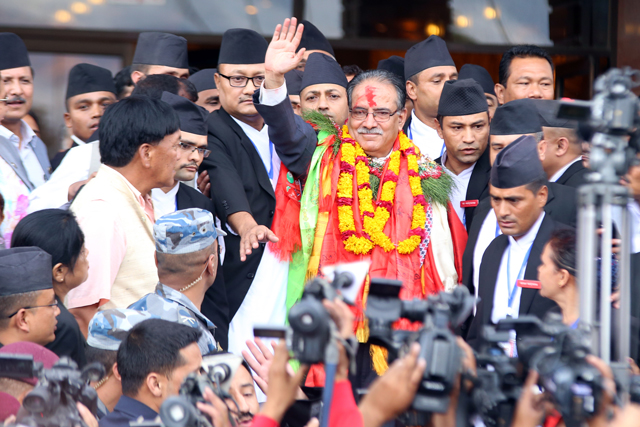
 Chairman of CPN (Maoist-Center) Pushpa Kamal Dahal after being elected as the 39th prime minister of Nepal outside the Parliament on Wednesday. Pic: RSS
Kunda Dixit
The return of Maoist Chairman Pushpa Kamal Dahal to Baluwatar, and his alliance with Sher Bahadur Deuba of the Nepali Congress this week prove right two adages in politics: no matter how ignominious the fall a politician always lives to see another day, and there are no permanent enemies in politics.
Dahal’s transition from Comrade Prachanda to his first swearing in as prime minister in 2008, his resignation following an unsuccessful attempt to sack the Army chief, his humiliating defeat in the 2013 election, the years in the wilderness, and his final comeback this week mark the man as a survivor.
For a long time after the conflict started in 1996, many in Kathmandu were convinced Comrade Prachanda did not exist. People had heard of Baburam Bhattarai from his activist days. Krishna Bahadur Mahara was even a member of parliament. But who was this Prachanda fellow?
Dahal was born in a hardscrabble family from Tanahu which was among many thousands who were part of King Mahindra’s transmigration to relocate hill families to Chitwan. His father was a frontiersman, farming and raising a family at the edge of the jungle. It wasn’t easier to survive in the plains, either — the family had to battle wild beasts, rapacious moneylenders and a government in Kathmandu which abandoned resettled farmers to fend for themselves.
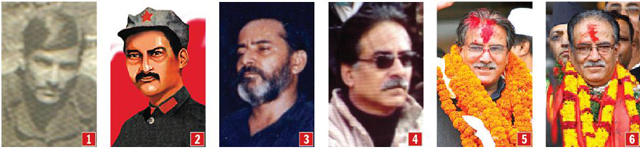 EVOLUTION OF A REVOLUTIONARY: When the war started in 1996, no one had heard of Prachanda. There was only a rare faded photograph of him from the 1970s while he was a young teacher in Gorkha (1). By 2000, a drawing of a man in a turtleneck sweater started appearing in pamphlets and newspapers. Based on various images, Nepali Times cartoonist Subhas Rai even made a likeness of the man from an artistic imagination (2). Then the army got hold of a group photo from a captured Maoist in 2001 that had a bearded Prachanda (3). In later photographs he is seen looking a bit like Omar Sharif (4). Pushpa Kamal Dahal after winning in the 2008 elections (5). And on Wednesday after winning the vote in parliament to be prime minister for the second time (6).
In college, Dahal was strongly influenced by communist ideology. He had seen Nepal's yawning economic gulf at first hand while growing up in Chitwan. "I never really understood why we had to struggle so hard to survive from day to day while our neighbours had all the luxuries," Dahal once told an interviewer.
In 1980, at the age of 25, Dahal became a member of the Communist Party, which was in the throes of a split, reflecting fissures in the international communist movement itself. Nepal's senior communists made a strong impression on him, but he later disagreed with them about his conviction that only an armed struggle would bring Nepal out of feudalism.
Dahal enrolled at the Agriculture Campus in Rampur, Chitwan, established with American aid and had ironically become a hotbed for leftist politics. After graduation in 1976 Dahal spent two years in a teaching job in Gorkha's Arughat, where colleagues remember he kept banned communist literature in tin trunk under his bed.
After his teaching job, Dahal did a brief stint at the US-funded Rapti Project, and discovered just how wasteful foreign aid was, how it makes people even more dependent. He was also riled by the segregation between Nepalis and Americans in the project office. By the mid-1990s Salyan, Rolpa, Jajarkot and Pyuthan were as underdeveloped as ever. He has said it was his experience in the Rapti Project that primed him for armed struggle.