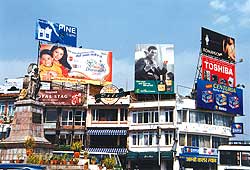
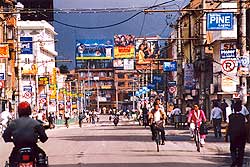
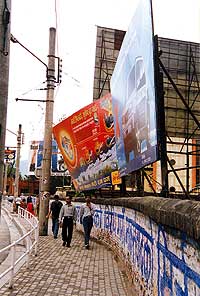
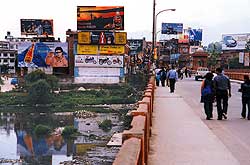
At the rate we are going, Kathmandu is going to turn into billboard-ville. The numerous billboards are blocking views of the mountains, towering over rooftops and presenting health hazards in stormy weather.
New computer technology has led to digitally designed and manufactured advertisements that have replaced the old hand-painted signs with photographic quality reproductions. This has made hoardings more attractive, but hasn't done much to enhance the aesthetics of this once beautiful city. It's pretty much a free-for-all: there are no rules about billboards-there is even a large neon sign in front of the royal palace in Durbar Marg and temple squares are marred by advertisments for instant noodles.
There is a certain nostalgia when remembering the way it was. Painters would perch on precariously rigged bamboo scaffolding and recreate images from A4 size pages to fit canvases that measured 15m X 13m. It didn't matter that the airplanes they drew resembled sharks. Everyday passersby would guess at what would unfold. The end result ranged from superb to downright strange.
An example of the latter is an advertisement for a lubricant that still survives on the left-hand incline past the stadium. The face and eyes of a tiger have been rendered with care and precision but the rest looks like the master painter had enough and handed his brushes over to a near sighted apprentice.
The digitisation of the process and means of billboard advertising has meant a revolution in costs, in terms of both time and money, which explains why driving down Bagmati Bridge towards Patan now looks like we're reaching saturation point. Of course we aren't, because as the people selling space realise, the sky is quite literally the limit.
Painters used to charge Rs 10,000 for messages that averaged 450 square feet and although digital printing costs almost three times as much, the quality is far better and the reproduction is much faster. In the competitive business environment time is money, and most advertising agencies and their clients are ready to absorb the higher cost. "Digital printing is not expensive compared to what people used to spend for painting boards," says Anil K Thaman of Sea Services that specialises in computerised billboard messages. "If you want a billboard for your product today, it will be up within the next 24 hours," he promises.
But good news for advertisers does not translate into profits for the government. More than 40 percent of billboards and hoardings dotting the Valley's streets are built on private property and therefore, are exempt from prices set by the Kathmandu Municipal Corporation (KMC). The corporation has a fixed rate of Rs 60 per square feet per year for advertising products other than alcohol and tobacco at public places. Those two categories have to pay 50 percent more. Private hoardings escape these steep charges because as Deputy Superintendent of KMC's city police admits, "We are not allowed to enter private houses, especially if women own the property."
Another area where the municipality find themselves helpless is the Guthi Sansthan. The law declares that billboards must not hinder traffic, cause public threat or use offensive signs and messages-none of which is adhered to with any measure of regulation. "They are visual polluters," says Renchin Yonjan, who was once part of a KMC drive to beautify the city.
Alcoholic beverages that are not allowed to be advertised through the electronic media have increasingly begun to find their niche on hoardings and billboards. The Khetan Group, for instance, spends around 50 percent of its advertising budget to market its beer and noodle products. "The idea is quite effective," says Rajendra Khetan.
Business houses believe there is a select range of products that should be put on billboards. It all depends on "the width and depth" of the products, according to Binod Chaudhary of the Chaudhary Group of Industries.