
 |
JANAKPUR—Until the mid-nineties, only the registration clerk in the CDO Office knew the names of newspapers published from this town. In those days, papers were like calling cards of their owners, who used their publications to advance business interests.
With very little advertising other than government notices, the main source of revenue for local newspapers used to be official grants from the information ministry and unofficial doles from bureaucrats, police officers and politicos.
A prominent bookseller remembers how entrepreneurs would beg him to display their papers, knowing full well that nobody was going to pick up a copy. The purpose of the exhibit would be to impress people who came to buy Hindi or English Indian dailies.
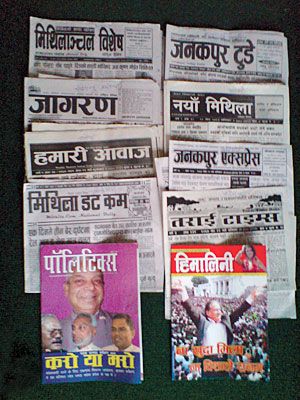
The pattern of media consumption changed irrevocably with the Madhes Uprising in 2006. Most 'national' newspapers began to be perceived as pro-Pahadi and anti-Madhes. Local publications increased their print run and began to attract some advertising. The popularity of FM radio, too, helped enhance the prestige of some papers as journalists often worked across several mediums and emerged as regular stringers for national and international broadcasters.
In addition to half a dozen FM broadcasters, at least nine daily newspapers are now published from Dhanusha district alone. Their circulation figures are still closely guarded secrets. But unlike in the past, almost all these dailies can now be bought from newsstands at the bus depot, the railway station or market streets.
The boom in media has not been without problems. There is a severe shortage of trained personnel. Publishers are still opaque about funding sources. Journalists work for a pittance. Most publications do very little to hide their political inclinations. The best person to judge the tilt of local newspapers is often the hawker who has to push them to separate sets of loyalists.
Deep Narayan Sah has been selling newspapers at Janak Chowk for the last 40 years. He has seen editors cowering in front of the anchaladhises of the Panchayat era. He has watched some journalists act like orderlies for officers of the security forces. He has observed politicians handing out cash. He doesn't like to talk about all that. But he pulls no punches when asked about the political loyalties of the publications he sells.