
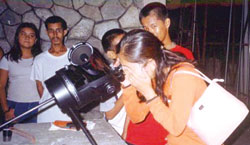
 With the entire nation busy assessing the country's history in order to chart a roadmap to the future, why should we stargazers be left out?
The remnants of stone-henge (chhate-dhunga) in Tehrathum andother districts show that during the Middle Ages, Nepali astronomers used such structures to track the position of the Sun (solstices and equinoxes). In 1790 AD, Laxmi Dutta Pande made the first sundial (dhup ghadi), which is now kept at the National Museum. In 1910, Bir Sumsher installed a sundial at Ghantaghar with support from the British. In the early 1970s, Prof Keshav Ram Joshi of Balmiki College brought the first telescope to Nepal from Russia and organized public observations at Tundikhel.
However, institutional initiatives to develop astronomy were taken only in 1995, when the government established the BP Koirala Planetarium and Science Museum Development Board. Over the past decade, the board has been unable to run neither the planetarium nor the observatory. It has been reported that the Board recently acquired a 16-in telescope, only to find out later that they don't have the skills to operate it! This is certainly irresponsible behaviour and misuse of scarce public resources.
Now, with BP Koirala's brother GP in power, amateur astronomers are expecting that the Planetarium Development Board will be reshuffled to make it more result-oriented. It is highly embarrassing that, four centuries after the telescope was invented, astronomy in Nepal is moving at the pace of a tortoise!