|
|
An April 2007 poll conducted by the Nepali team of the South Asia Democracy Study Group in collaboration with International Institute for Democracy and Electoral Assistance (IDEA) explores the state of democracy in Nepal. The first round of the survey was conducted in 2004.
The survey shows that the 250-year-old Shah dynasty is likely to become a victim of the popular aspiration for change- 59 percent of respondents chose a republic over retaining the monarchy. In the 2004 survey, only 15 percent did so. And this increase is not because of the royal massacre, the royal takeovers, or the tarnished image of royalty, but on principle. Two-thirds of the republican respondents wanted a government 'ruled by the people' or believed 'monarchy is not necessary in the modern era'.
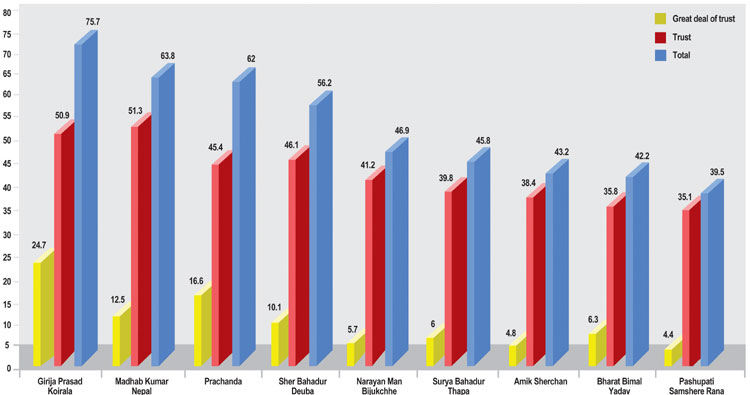
People buy the Maoists' agenda, but trust other state and political institutions more.
Two-thirds of the respondents 'believe' the changing ideological position of the CPN-M to varying degrees. This change in popular perception is reflected in responses to other questions too. Only 7 percent of those surveyed consider the Maoists as a source of insecurity, compared with 42 percent in 2004. The CPN-M topped the list of those sympathetic to the cause of excluded groups. Respondents were on board with the Maoist proposals to integrate the two armies (74 percent) and impose a land ceiling (61 percent).
Still, Nepalis trust the other seven political institutions more. Of the 934 respondents (from a total of 4,089) who identified themselves as close to a party, only 15 percent named the CPN-M, while 34 percent allied themselves with the NC and 32 percent with the UML. Over half said they would either decide later for whom they would vote or did not want to tell.
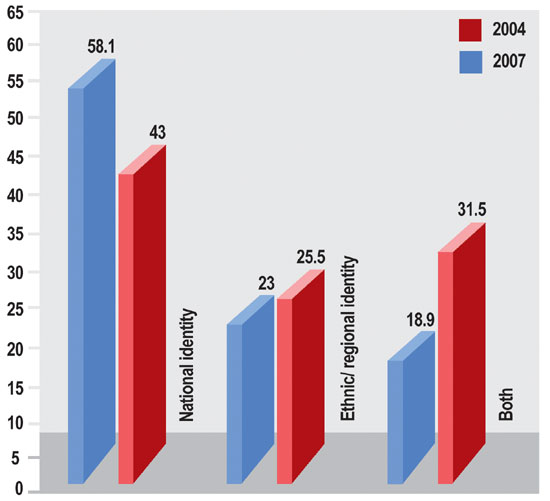
Popular aspirations for change have been manifesting in different forms. The janajati and madhesi movements appear to be genuinely mass-based. Respondents identifying with just national identity dropped sharply to 43 percent from 59 percent in 2004. Instead, there has been a shift in favour of equal weight to both national and ethnic or regional identity, from 19 percent in 2004 to 31.5 percent. It's different in the tarai, though. Across caste, ethnicity, and religion, madhesis favoured an ethnic or regional identity (30 percent on average) over a national identity (18 percent). The figures were reversed in 2004. But identity politics do not threaten national integration-over 90 percent of respondents, including madhesis, said they 'are proud' to belong of their own community and also Nepali.
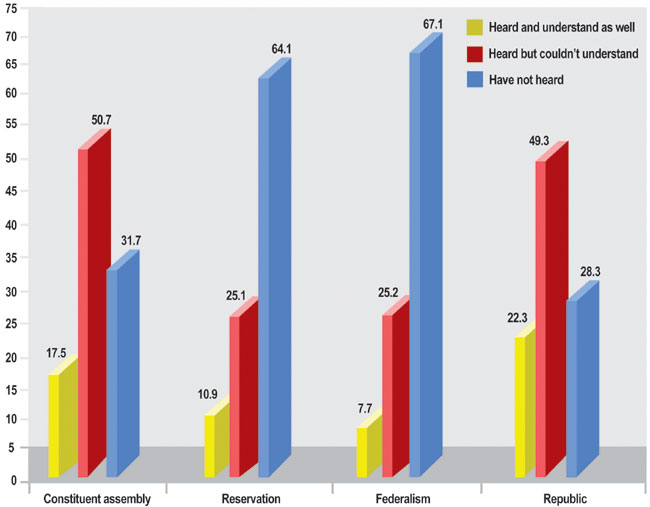
The 'New Nepal' project aims to make fundamental changes to the state-secularism, federalism, and multilingualism. The survey discovered a paradox: support for a secular state, bi/multi-language policy, and federalism has increased by 6. 4 and 9.5 percent respectively since 2004. Yet 61 percent of respondents favoured retaining the Hindu state and a little less than that wanted a unitary form of government. A bi/multi-language policy, however, is endorsed by over half the respondents.