
VARANASI-- The chant of ‘Har har Modi’ filled the air in Hinduism’s holiest city of Varanasi. That the supporters of Narendra Modi dared to equate him with Lord Shiva was audacious. Modi is the candidate from the Hindu right BJP in India’s elections next month. Challenging him in Varansi is the leader of the citizen’s party, the AAP.
At a recent campaign rally in the city, Kejriwal had been criticising Modi’s Gujarat model of development when the muezzin’s call to prayer rent the air. Kejriwal paused in his speech. At the end of azaan, a cry of “Har Har Mahadev” arose, joined by thousands of voices, of which many belonged to Muslims. Perhaps never before had a Hindu symbol or slogan been usurped from the BJP, that too, for uniting rather than dividing people.
Those few seconds symbolised Varanasi’s syncretic mixture of Hinduism and Islam. Varanasi lives in binaries. The heaps of garbage mock its holiness. And Modi’s decision to contest from Varanasi has triggered a countervailing force, now coalescing around Kejriwal.
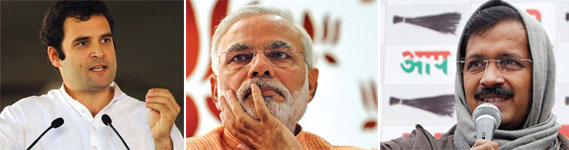
Modi and Kejriwal exemplify two contrasting philosophies and personalities. Modi has assiduously cultivated a persona of a decisive leader, emphasises growth, flaunts his proximity to big business, and dislikes engaging in debates. He struts and throws innuendos against his rivals, puffing up his 56-inch chest. Though his campaign focuses on development, to his obsessive followers he quintessentially remains the Emperor of the Hindu soul (Hindu Hriday Samrat).
Kejriwal, on the other hand, is puny, and in every way the man next door. He refuses to make the sartorial switch from the pant-shirt ensemble to kurta-pajama. This places him outside the entrenched political class, and imparts credibility to his stinging attacks against the politicians, their corrupt ways, their symbiotic relationship with big business. He rails against the development model he feels is loaded against ordinary folks, particularly farmers.
And it is in Varanasi that the epic battle is being waged between the larger-than-life personality of Modi and the perceived moral authority of Kejriwal.
It is a complex electoral arithmetic. No longer is it enough to add the number of Brahmin voters to those of Vaishya caste and credit it to the BJP’s electoral account. You can’t assume that Modi is bound to receive the overwhelming support of Kurmis, a peasant caste. A good many Kurmis are inclined to AAP, applauding it for highlighting the appropriation of agricultural land to benefit industrialists. There are Dalits whose loyalty to the matriarch UP chief minister Mayawati wears thin, and are split in their admiration for Modi and Kejriwal.
Indeed, both have an appeal cutting across the caste divide. Modi’s platform is grassroots Hinduism with the Gujarat development model. Kejriwal’s crusade against corruption resonates across the religious, caste and class divide, especially in Varanasi where the crumbling infrastructure is blamed on corruption.
This isn’t to imply that caste identities have melted away. But there are cracks in the mould of India’s identity politics, perhaps because of two national personalities contesting from Varanasi. The reason caste divisions are eroding is partly due to migration to metros and people thinking beyond the politics of identity.
Reservation of jobs for the disadvantaged is now considered an irreversible aspect of social reality, blunting the backlash from the upper crust. Then there is the inability of subaltern caste leaders to meld together the heterogeneous Dalits through policies to improve their economic conditions.
Kejriwal has goodwill among Muslims for taking the fight into Modi’s Gujarat, but this is not grounded in the politics of identity. The popular refrain among Muslim voters is that Kejriwal speaks of social and economic justice, which is what the community wants.
Incredible as it may sound, Modi hasn’t as yet won Varanasi, as India’s mainstream media make it out to be.
ashrafajaz3@gmail.com
Read also:
Modi's momentum, KANAK MANI DIXIT