
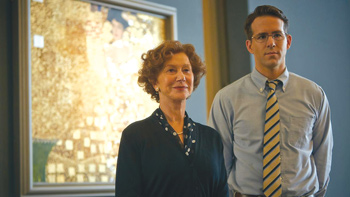
Occasionally Hollywood will churn out an imperfect film that is still utterly captivating. The Woman in Gold is one of those odd little films that could so easily have tended towards formulaic banality had it not been for the focused talents of its two main characters.
Based on the real life story of Maria Altmann, played by the wonderful Helen Mirren, the film deals with the epic case of Altmann’s fight against the Austrian government to retrieve enormously valuable paintings that had belonged to her family, a wealthy, immensely sophisticated Jewish industrialists living in Vienna, who lost everything they owned due to the advent of Nazi influence in Austria.Ostracised and impoverished, Altmann (née Bloch-Bauer, Adele was her aunt by marriage) leaves Austria behind with her husband for the United Stated determined to begin anew.
It is only years later, with the help of Randol/Randy Schoenberg (Ryan Reynolds) a lawyer son of another Austrian-Jewish friend, that she begins a decade long struggle to regain ownership of her family’s lost property.
The case of the ‘Adele Bloch-Bauer’ (or ‘The Woman in Gold’ as it came to be known) painting was a historic one for many reasons. After the war, the Klimt paintings commissioned by the Bloch-Bauer family were displayed at the famous Belvedere House in Vienna, quickly becoming synonymous with Austrian culture. As a result, in addition to complex legalities, the Austrian government was also extremely reluctant to concede the moral and ethical issues linked to the public absorption of paintings seized during the holocaust, aware that returning the Klimt paintings to Altmann could set a precedent for hundreds of such claims in the future.