
In Kathmandu, a capital city that lacks basic sanitation facilities, an elderly man from the Tarai is forced to take a roadside leak. A local man pelts a stone and curses him. The next day, the same man humiliates the old man in front of his son by trying to publicly pull down his dhoti. The young boy holds on to his father’s hand as the old man runs away.
Two decades later, the boy has grown up to be a young man, and is working hard to ensure that the next generation of Nepal’s Madhesi people do not have to live in fear and humiliation in their own land.
Hundreds of kilometres away in the remote hills of Rolpa district, another young boy joins an armed rebellion to undo historical wrongs. For the next 15 years, he fought his own government and wrote songs of awareness to instill passion and indignation in the hearts of his fellow comrades. Mal Bahadur Budhamagar and thousands like him sacrificed their youth for a life of dignity.
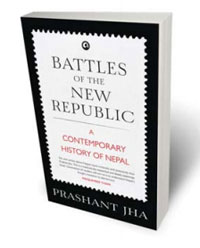
Aleph Book Company, 2014
Paperback, Rs 635, 288PP
Prashant Jha’s Battles of the New Republic: A Contemporary History of Nepal will anger and shame us at the same time for being part of a society that has failed to stand up for its weakest and most unfortunate. Divided into four sections, the book is the personal account of a journalist as he discovers underlying causes of an insurgency. It is about the people who joined the rebellions, those who betrayed it, and those who amassed personal and political fortune cashing in on the misery of Nepalis.
The book goes back and forth in history to explain behind-the-scene events that shaped our immediate past and present. We see how ego and ambitions prompted Girija Prasad Koirala to thwart peace efforts during the Krishna Prasad Bhattarai government. The favour was returned by Sher Bahadur Deuba few years later, when Koirala’s own effort to broker peace with the Maoists failed.
Based on interviews with protagonists and fact checked with others who were there, Jha unravels what was happening in the corridors of power. But he has also managed to capture the mood on the streets, for example, that led to the rise of the Madhes-based parties and their leadership through the stories of citizens who were part of the movement. This is also a subaltern history.