
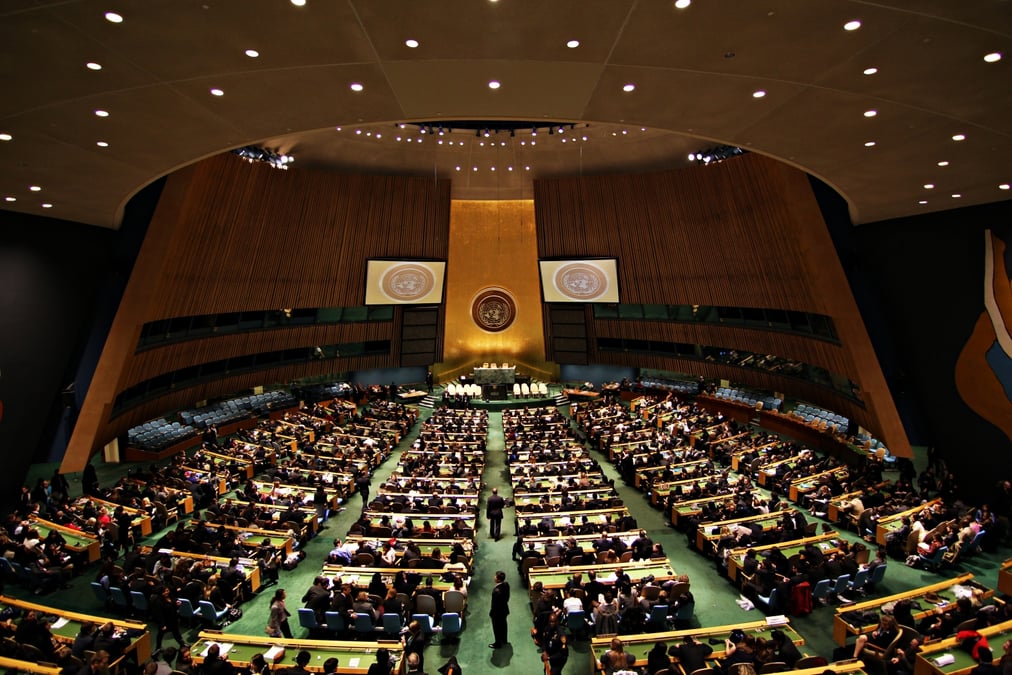
The annual United Nations General Assembly is always an occasion for taking stock of the state of the world. But this year, on the 80th anniversary of the UN’s founding, it was also an occasion to take stock of the organisation itself.
By any measure, the UN’s situation is dire. While Russian aggression against Ukraine and mounting tensions between the United States and China cannot be blamed on the UN, they do highlight a fundamental problem. The UN Security Council – where China, Russia, and the US each wield a veto – is locked in a permanent confrontation over one issue or another, blocking the rest of the organisation from moving forward on almost anything.
Consider the situation in the Middle East, where the UN has played a central role in conflict resolution and peacemaking ever since the State of Israel was established (under a UN resolution). Numerous UN peacekeeping operations in the region have helped to alleviate tensions, and massive humanitarian efforts, primarily aimed at Palestinian refugee communities, have saved countless lives. While the UN has not forged a lasting peace, it has certainly helped prevent some wars and shorten others.
In recent years, however, the UN has increasingly been sidelined. The so-called Quartet – the UN, the US, the European Union, and Russia – is now a distant memory, and numerous UN operations have come under direct attack, primarily by Israel. The Israeli government not only questions the humanitarian efforts of UNRWA (the UN Relief and Works Agency for Palestine Refugees) but now also blocks the organisation’s work whenever it can.
Before Hamas’s October 7, 2023, attack on Israel, the UN was essential to keeping the situation in Gaza relatively stable. Though it couldn’t overcome divisions among the Palestinians, especially after Hamas assumed power in Gaza in 2006, it could, and did, help provide the basic means of survival for the enclave’s two million people. But now Israel has questioned or attacked virtually every aspect of the UN’s work on this issue, and it could not have done so without America’s tacit support. US President Donald Trump, in particular, has proved willing to accept virtually everything that Israeli Prime Minister Binyamin Netanyahu’s extremist government does.
Meanwhile, the UN has struggled to mobilise an effective response in South Sudan, a semi-failed state, and in Sudan, where a devastating civil war is entering its third year. Similarly, from the Katanga secession in 1960-63 to the recent peace operations in northeastern Congo, Central Africa continues to preoccupy UN peacekeepers and mediators.