
Ratna Sansar Shrestha, a former board member of Nepal Electricity Authority, speaks to us about the effects of the new electricity ordinance that will break the NEA into three components.
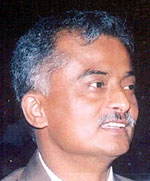 Nepali Times: What do you think about the electricity ordinance?
Ratna Sansar Shrestha: Actually, I'm not fundamentally opposed to unbundling. I believe competition in the electricity sector will definitely help consumers as well as other stakeholders and make the market itself competitive. I am more apprehensive about implementation. So, instead of one big sick organisation that is losing Rs 2 billion per year we may just end up with three small sick organisations.
Why is the idea being mooted, especially by the means of ordinances, at this time?
That is a mystery to me. I don't see why the hurry at a time of instability which means there isn't a wider discussion on the pros and cons. Besides, splitting the NEA has long term implications, while an ordinance is an instrument valid for six months only.
Why wasn't it put forward when your team was in the NEA?
The new Hydropower Development Policy 2001, did envisage unbundling the NEA but parliament survived only six months after that. By the time I was nominated to the NEA board parliament had been dissolved. But I can confide in you that we did start work on unbundling the NEA which to an extent has paved the way for the present move.
In the early 1980s donors including the ADB helped set up the NEA now they want it dismantled. Changing horses in midstream seems to be as much a donor habit.
Yes, poorer economies like ours have been subjected to the covenants imposed by these multilaterals and many of their conditionalties are problematic. If one looks at this particular concept dispassionately it is clear NEA has too small a system (just about 465MW of its own and about 149MW belonging to IPPs, already unbundled) to warrant splitting. The action could very well end up costing more to consumers as the unbundling only increases the number of institutions ending up as an opportunity for powers-to-be to hire more CEOs and leading to unnecessarily high expenses. Besides, post-unbundled successors of NEA could still continue to be subjected to interference from bureaucrats and politicians.
So you think it may not be the right solution?
In Nepal many plans that look sound on the drawing board have floundered when put to practice. There is a danger the economic model will be called total failure and people will again clamour for reintegration of the NEA. This will be very messy. The ordinance has a single-minded focus on splitting the NEA while it is silent
on how competition at both wholesale and retail levels will be instituted.