
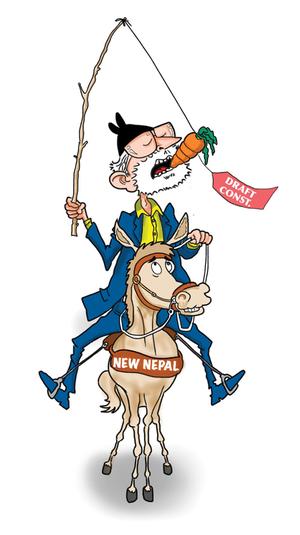
Even skeptics who had described the government’s public consultation on the draft constitution as a sham had to reluctantly admit that it went quite well. The Madhesi parties and the Hindu royalist Rashtriya Prajatantra Party-Nepal (RPP-N) rejected both the draft and the feedback exercise, and the breakway UCPN-M even forcibly shut down the country by indulging in arson to terrorise the people. However, the enthusiasm with which Nepalis from all walks of life took part, rain or shine, in the process proved the public’s acceptance of this part of constitution writing.
Suggestions range from the absurd to the sublime. But there is quite a chunk in the middle that is truly the voice of the people, and raises their concerns about development, decentralisation, citizenship, equality. Their message is clear: the draft is flawed, needs to be improved and the disgruntled Madhesi parties’ participation in the process is necessary. Now, the four main political parties behind the 16-point deal (which was actually an excuse for regime change post-earthquake) need to grasp this message and turn it into an opportunity to engage the parties who did not sign in on the 16-point agreement.
People from across the country have expressed their concerns mainly over demarcation of federal provinces, citizenship provisions, secularism, inclusion and form of governance.
No surprise, these were the very issues that had stalled the draft for six long years. Most of the worries are genuine. For example, a dubious sentence that ‘only those born in Nepal will get citizenship by descent’ has raised fears of statelessness among those Nepalis who live near the border and go to Indian hospitals to deliver babies. The provision that forces Nepali women to prove that their husbands are Nepali has also enraged many.
People have also reminded the political parties that they had pledged federalism with demarcation before the Constituent Assembly (CA) elections, and promulgating the new constitution without names and boundaries of federal provinces will be violation of a Supreme Court (SC) order.
So, the parties now need to agree on a fresh deal to name and demarcate federal provinces before passing the new constitution. That will not just be honouring the SC order but also ensuring that the disgruntled Madhesi and Janjatis are not left out. given that this was the sticking point for eight long years, a compromise will leave most (if not all) dissatisfied.