
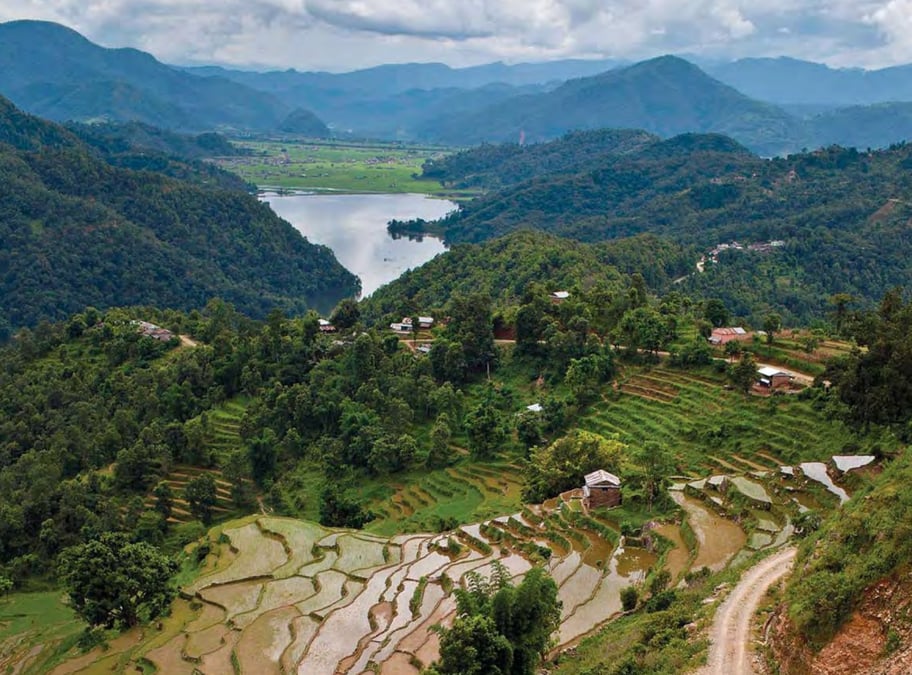
Extreme weather caused by climate breakdown, disruption of global supply chains and domestic mismanagement have created a perfect storm affecting Nepal’s food security.
At no time has the nexus between water, energy and food been as starkly evident as this year. More than 60% of Nepal’s farms are rain-fed, and the annual fertiliser shortage has been aggravated by the West Asia war, even as rural outmigration leaves farms fallow.
Paddy Day on 29 June last week was subdued; there was little playful mud-wrestling and even little planting. A wetter than usual pre-monsoon led many farmers to plant rice early, but then the actual monsoon was delayed by two weeks.
Erratic monsoons make this a recurring pattern across Nepal. Many farmers have given up waiting for rain and migrated for work.
Scanty rain lowered rice harvests to 5.7 million tonnes in 2024/25 from 6 million the previous year. Weather models tracking the Super El Niño forecast severe drought, and combined with the fertiliser shortage, this will further fall in grain harvests.
“Nepal’s production of staples like rice is hostage to climate shocks, and this year the El Niño phenomenon means less than average rainfall,” explains Krishna Pahari, Livelihood and Food Security expert at the Nepal Development Research Institute.
Pahari spoke to Nepali Times from Rome, where he is attending an international nutrition conference. He added: “The climate crisis is compounded by conflict in West Asia that has led to fuel and fertiliser shortage; if these problems persist, Nepal’s food security situation will worsen.”
Nepal was once a net exporter of food, but those days are long gone. Many of the structural problems with agriculture predate the climate crisis, but unreliable monsoons and lack of irrigation have made the situation more dire. Last year, Nepal imported more than 1 million tonnes of grain worth Rs60 billion.
“Nepal is severely impacted by the climate crisis, but we lack solid recovery plans when agricultural and forest resources are lost to frequent, climate-induced disasters,” says Yamuna Ghale, food security and governance expert at the Institute for Integrated Development Studies in Kathmandu.
She adds, “There is inadequate resource allocation in developing climate-responsive, nutrient-dense seeds and breeds; as a result, we have to depend on imports and aid.”
Sixty percent of Nepalese are engaged in farming, and agriculture makes up a quarter of the GDP. But there is a mass migration of rural youth, and those who remain do not get a reasonable price for their cash crops.
In mid-June, the South Korean government, through its Korea International Cooperation Agency (KOICA), pledged a $12 million grant for a six-year project to boost climate-resilient rice production and food security in the Tarai.
Irrigation can increase Nepal’s agricultural productivity by as much as 30%, experts say, but major irrigation projects have been stalled for decades because of corruption and mismanagement.
While increased productivity is a priority, there is a need to protect and sustain whatever is produced in the first place. Post-harvest loss ranges from 15% for cereals to as much as 40% to 50% for vegetables and fruits. Wildlife raids also destroy standing crops, resulting in more outmigration.
“Reducing post-harvest loss means increasing the amount of food available for the people,” notes Pahari. “For that, we need more cold chain systems, storage facilities and improved storage silos.”
Other measures involve diversifying food so it will keep for longer. Fruits can be dried and turned into jam. And in case of school lunches, recipes and menus can be modified to fit children' s taste.
ZERO HUNGER
Nepal’s gains in reducing stunting and wasting have been impacted by the pullout of development aid in recent years, hindering commitments to zero hunger by 2030 per the Sustainable Development Goals.
Last month, the results of a nationwide survey of 1 million children under five across Nepal supported by Helen Keller International revealed that the discontinuation of USAID-funded food and nutrition programs had increased childhood malnutrition. It found that acute malnutrition had increased from 6.6% in 2025 to 7.8% this year, with Madhes Province having the highest rate of malnutrition at 12.3%.
“We are not on track to meet the zero hunger targets by 2030,” Pahari said. “The progress in average household food consumption is because of remittances and social protection programs.”
All this now begs the question: what has the RSP government done about addressing increasing food production and reducing childhood hunger?
Finance Minister Swarnim Wagle said in his budget speech in May that reviving the agricultural sector was “top priority”. But the Rs47 billion allocated for agriculture is less than 3% of the total budget and is the lowest amount set aside for the sector in nine years.
More than half of this allocation is for chemical fertiliser imports alone, but even so, there is an annual shortage of urea at paddy planting time.
Some experts say Wagle’s emphasis on promoting commercial agriculture and raising middle-class income would create rural jobs and raise productivity across the value chain. Critics say this will come at the expense of poorer farmers.
“This budget is geared towards mobilising Nepal’s middle-income group, which makes sense in some ways, but most of our farmers are smallholders,” says Pahari. “Unless we address that group, we cannot make a positive impact on the increasing overall production.”
Yamuna Ghale believes that, like everything else, the solution lies in political priorities and policy implementation. She says, “Policies are political, and what the new policies and the size of the budget tell us is that agriculture is not a priority for this government. The impact of this is most keenly felt by those from marginalised and excluded communities.”
Provinces have fared a bit better in their agricultural budget allocation. Karnali, which has the highest level of household food insecurity, has set aside more than 21% of its budget for agriculture. Meanwhile, Lumbini and Madhes, where acute malnutrition rates are highest, have set aside over 4% of their funds for farming.
Ghale was the moderator of a panel on regional collaboration and policy action to shape a shared food future in South Asia at a World Bank regional policy dialogue in Ahmedabad earlier this month.
Participants included experts, innovators, and members of the private sector from across South Asia, but unlike other countries, Nepal’s government representatives were notably absent. Declining such invitations has been standard practice for the new leadership, which has prioritised “solving issues at home”.
Some attendees noted that the absence of Nepal’s new leadership from the event was a missed opportunity to usher in a paradigm shift in agriculture to link incentives, production, and markets right across the value chain.
Interestingly, both Krishna Pahari and Yamuna Ghale used the same words to sum up: “Food security is national security.”
This article is brought to you by Nepali Times, in collaboration with INPS Japan and Soka Gakkai International, in consultative status with UN ECOSOC.
