
 MIN RATNA BAJRACHARYA |
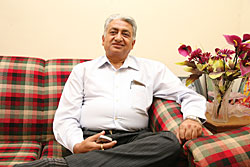
It was social action rather than a hunger for power that first got Upadhyay involved in politics. He studied pharmacy at Banaras Hindu University under the Colombo scholarship plan but failed to complete the course because sustained strike action kept the university closed. In the early '70s, he returned to Nepal and became a social activist.
Although he was born in Kathmandu, his family moved to Kapilbastu after buying some land at auction. He launched a sanitation campaign and started infrastructure development in his Tharu-dominated village Bhadsaruwa, work that earned him popularity and enabled him to get elected as Pradhan Pancha and later as member of the District Panchayat.
After the NC offered him party membership he attended its Palpa Convention where he happened to meet BP Koirala. After the referendum in 1980 he participated in the general election although the NC had boycotted it. "It was a symbolic participation to gauge the party's influence," he recalls.
After the success of the 1990 movement, he was elected to the parliament Kapilbastu 2 in the 1992 and 1995 elections but lost in 1998. But soon after the NC formed a majority government following the 1992 election cracks started to appear within the party because of conflict between the party president KP Bhattarai and the parliamentary party leader and prime minister GP Koirala. The internal conflict finally resulted in the launch of a separate party in 2001 named NC(D) led by Sher Bahadur Deuba.
Upadhyay joined Deuba's party as a central committee member. "It was a revolt against the party's undemocratic practices," he recalls, "a party can never be a one man show."
Today's politics worries him. "Why don't we realise that we are all in the same boat that we are rocking?" he questions, "We don't learn lessons and forge consensus."
Upadhyay is in the National Interest Protection Committee in the CA, the first to submit its draft by the deadline. So far only three out of the 11 CA thematic committees have submitted their drafts even though the deadline was a month ago. But is still optimistic that the constitution can be written on time if leaders give priority to it.
Upadhyay has greater belief in the wisdom of the Nepali people than of the leaders.
Present arms
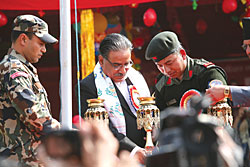
Weak civilian leadership is encouraging militarism
DHRUBA KUMAR
 KIRAN PANDAY |
Militarism in Nepal is a cultural residue of the Gorkhali conquest of territory to build a unified country in the 18th century. The contribution of the armed forces in the state-building process was crucial for 'national integration' in which aggression and conquest were employed overwhelming rather than negotiation and persuasion.
Though the military is the state builder, militarism and the military in Nepal are perceived and portrayed as a brutal force, violator of public norms with systematic malevolence, and unlawful interference in civil affairs. Military service, at least in the officer corps, has been an elite preserve. Until 1951, the power and political elite ruling Nepal considered the military profession their birthright. It was also the shortest route to political success since during the 104 years of Rana rule, one of the four Commanding Generals always went on to be prime minister.