|
|
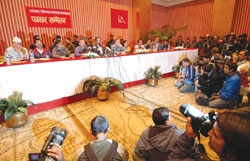
| NO LONGER REBELS: Maoist chief Pushpa Kamal Dahal at his first open press conference after coming aboveground, with senior comrades including Deb Gurung, Krishna Mahara, Baburam Bhattarai, Ram Bahadur Thapa, Dinanath Sharma, and his wife Sita Poudyal. |
The agreement, when it came at midnight, was greeted the morning after with a combination of over-the-top optimism and anger at the Maoist high-handedness in the capital.
But around the edges of the euphoria were hints of wariness and warning. "There comes only one chance on one day in an age," Pushpa Kamal Dahal quoted the late poet Gopal Prasad Rimal during his first public press conference in the capital on Wednesday. "I thought of the poem while signing the agreement," Dahal told reporters.
The fact that he was quoting a poem adopted by the UML is ironic at best. And another bad sign: jousting for political space and polarisation between parties has already begun in earnest. The Maoists claim they 'sacrificed' their decade-long rebellion, and Madhab Nepal claims his party is the binding force between the Maoists and the seven parties.
The two Congresses will likely wait and watch for the next few weeks, and move in to the growing rift caused by the tussle between the communists. The composition of the interim government was reached through meticulous seat-by-seat negotiation between all parties.
On paper, it seems as if the Maoists have gained little. But it was a major concession for the Congresses to hand an underground armed rebel movement almost an equal number of seats as they themselves have in the interim house. In practice, the 16 seats for non-party members will likely be filled by civil society leaders, many of whom have fairly consistently toed the Maoist line.
The militia, vigilante groups, and public security-and that of Maoist leaders-remain potential flashpoints. The arms management arrangement focuses, for the purposes of the deal, on the 'People's Liberation Army'. But the Maoist militia remain at large, and international human rights observers told us, on condition of anonymity, that senior militia leaders closest to the Maoist top brass went underground shortly before the deal was clinched.
The fear of reprisals, which made Dahal and Bhattarai ask for police protection for their headquarters in the capital right before the agreement was signed, is likely to be intense for most local rebel leaders. But some top militiamen told us they'd never give up their arms despite the agreement. A team of conflict experts which toured the tarai last week, also reported seeing small arms being brought over from India, reportedly for sale to militia in Morang. Two weeks ago a large cache of arms was raided in Morang's Bihuni village.