

 JEERAWAT NA THALANG |
At first glance, Nepal's numbers don't look good. The country remains one of the poorest in the world. Even though 70 per cent of the workforce is in farming, agriculture has stagnated, accounting for only about half that proportion in its contribution to the country's GDP. Since most rural families do not have sufficient work on their own farms, they migrate to do dirty, dangerous and difficult jobs abroad. This is tragic because our demographic dividend is being enjoyed by other countries that had no hand in nurturing our youth.
But there is a brighter side. Where authority has been entrusted to the people themselves, Nepalis have come up with world-class success stories. In the last couple of decades, Nepal's forests were not just restored from the brink of desertification, but were made more productive than in the past. This is so despite the recent plunder of selected Tarai forests, reportedly with the minister and officials colluding with smugglers and local politicians. The most disturbing thing about this looting is that none of the so-called major parties, the NC, UML or the Maoists, and not even the Prime Minister, have raised any objections against what seems like the officially sanctioned daylight robbery of the people's wealth in post-Jana Andolan II loktantrik Nepal.
Forestry is not the only area where Nepal has excelled. Of the 72 developing countries, Nepal is one among the seven countries projected to meet the Millennium Development Goal in child survival, and the only country to do so before 2015. In maternal mortality too, Nepal has earned international laurels and is projected to successfully bring the rate down to the MDG threshold of 134 deaths per 100,000 live births by 2015.
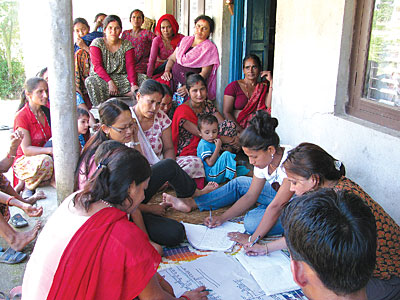
Then, there is the nationwide network of mostly self-managed microfinance institutions that promote income generating activities among the poor. The Small Farmer Cooperatives, built upon the then faltering (now terminated) Small Farmer Development Project of the Agricultural Development Bank, are outstanding examples in this respect. In its three-tiered structure, these groups at the grassroots perform basic saving and lending functions and exercise surveillance over members' use of credit to prevent possible delinquency. The existing evidence suggests that the members of these coops – who now number around 150,000 – are doing much better economically and socially. These coops have been highly regarded by external evaluators too.
With these internationally applauded feats on the one hand, and acute, chronic and widespread poverty, massive under- and unemployment, undernourished children (half of under-5 children designated as such), and the continuing departure of the labour force on the other, Nepal clearly stands out as a strange exercise in contrasts. However, a closer examination will tell us that the problem is basically political in its character. Given the massive poverty and pervasive lack of education among the people, 'democratic' elections in Nepal have generally been swayed by money, thus creating a perfect justification for greedy politicians to engage in corruption, and in the process, plunge the country into a vicious cycle with political corruptibility and widespread deprivation of the people reinforcing each other.
The above successes, however, show that sustainable and inclusive development remains an attainable proposition even under these adverse conditions, that local economies can still generate jobs and produce more, and that deficiency in education and poverty are no obstacle to the proper exercise of authority devolved to the users themselves.
The catalyst for our achievements in forestry was the institution of user groups of forest users themselves, which derived from the Decentralization Act of 1982. Today, there are over 15,000 forest user groups across the country managing their own commons. The concept of the 'user group' itself is indigenous to Nepal. In 1969/70 during my anthropological research for the then Royal Nepal Academy I ran into and studied a centuries-old traditional irrigation system in a Jumla village that was being efficiently managed by their own user institution, the Kumthi. As a civil servant, I was able to build the finding into government policy on user groups in the mid-70s and later, as the centrepiece of the Decentralization Act in 1982 that made the institution legally mandatory. It should however be noted that 'user groups' meant vesting the people themselves with power to govern, without limiting power to DDCs and VDCs, which too often have failed to deliver tangible results.