
Three incidents in one week: a detained traveller in Shanghai, a revived claim on Sindh, and a currency note from Kathmandu, reveal a South Asia where small symbols now carry the weight of territorial claims. The danger lies not in armies but in imaginations sharpened into weapons.
It began without spectacle, as many troubles in the subcontinent often do: quietly, almost indifferently, as though history were clearing its throat. A week steeped in a kind of comic solemnity, its events unfolding with the grave absurdity of men arguing over shadows cast on an old, uneven map. One could almost hear the creaking of history’s machinery, answering its own summons, as if reluctant to surrender its favourite mischiefs.
The first murmur, faint but unmistakable, came from Shanghai, where a young woman from Arunachal Pradesh found herself detained beneath the cold fluorescence of an airport hall. Chinese officials questioned her not-so-gently, an initiation into that peculiar fraternity of those whose identities are disputed not because of who they are, but because of where the lines on someone else’s map would prefer them to be.
And barely had that echo settled when India’s Defence Minister, with the ease of a man accustomed to speaking into the certainties of a friendly crowd, remarked that “Sindh may return to India one day.” He said it with the offhand confidence of a politician who knows mythic geography plays well at home.
But the remark, dropped into the region’s already crowded pool of dreams, loyalties, and inherited grievances, spread outward in ripples – provoking denunciations, apprehensions, and that familiar tightening of breath that accompanies any suggestion that the past might yet attempt a resurrection. In Pakistan, the words landed not as rhetoric but as portent, dredging up every anxiety sharpened by partition, war, and the belief that memory in South Asia, once stirred, is never quite satiated.
Then Nepal, with its quiet talent for announcing its displeasures through objects rather than declarations, unveiled its new currency notes: each one bearing the imprint of its 2020 political map.
Lipulekh, Kalapani, Limpiyadhura – names that have become ritual incantations in the theatre of Himalayan disputes, contested frontiers now printed in neat, official ink. The release was explained as routine. Nothing in this region is ever routine. The moment a boundary is drawn on money, it becomes more than a border. It becomes an assertion, a reminder, a pre-emptive negotiation.
Three events, scattered like windblown leaves across the subcontinent’s restless topography. None catastrophic, none decisive, yet each carrying the faint odour of things unresolved, things forgotten until the moment they are not.
The humour is thin, the unease is thick. They were small gestures: a passport, a proclamation, a banknote, but in South Asia, small gestures have a way of expanding into quarrels no one quite intended and no one quite knows how to end.
Beneath these small episodes lies the harder truth. The subcontinent has slipped into an era where symbols, not armies, do the fighting. Maps, murals, visas, banknotes, toponyms, remarks: each now carries the weight that artillery once did. The provocations are miniature, the meanings are immense. And the region reacts to each with a suspicion that borders on reflex.
China understands this vulnerability better than anyone and does not need to invent South Asia’s sensitivities. It merely needs to press on the ones that already exist. China’s refusal to accept an Arunachal Pradesh passport is not clerical fussiness, it is a demonstration of a worldview.
By turning a lone traveller into a pawn of territorial narrative, Beijing enforces its claim to “South Tibet” without firing a shot, and normalises its cartographic imagination through mundane encounters, where the humiliation is individual but the message is national.
It is sovereignty-by-bureaucracy, a slow, grinding assertion that does not need tanks to leave a bruise. The frontier now lives in the immigration cubicle, not just the mountain pass.
India’s 'Sindh may return' remark sits at the opposite pole. It neither denies the sovereignty of others nor confines itself within current boundaries. Instead, it breathes life into an older geography, one that extends far beyond India’s present outline. For Delhi, this is heritage. For Pakistan, heresy. For the region, it is another sign of a political climate in which myth, memory, and maps are all too easily woven into public rhetoric. And rhetoric, once spoken, becomes the shadow of intent.
Nepal’s cartographic gesture is its own form of resistance. It asserts that small states, too, possess symbolic weapons. A currency note bearing a disputed frontier is not merely a piece of paper, it is a refusal. And refusal, in South Asia, quickly acquires the density of principle.
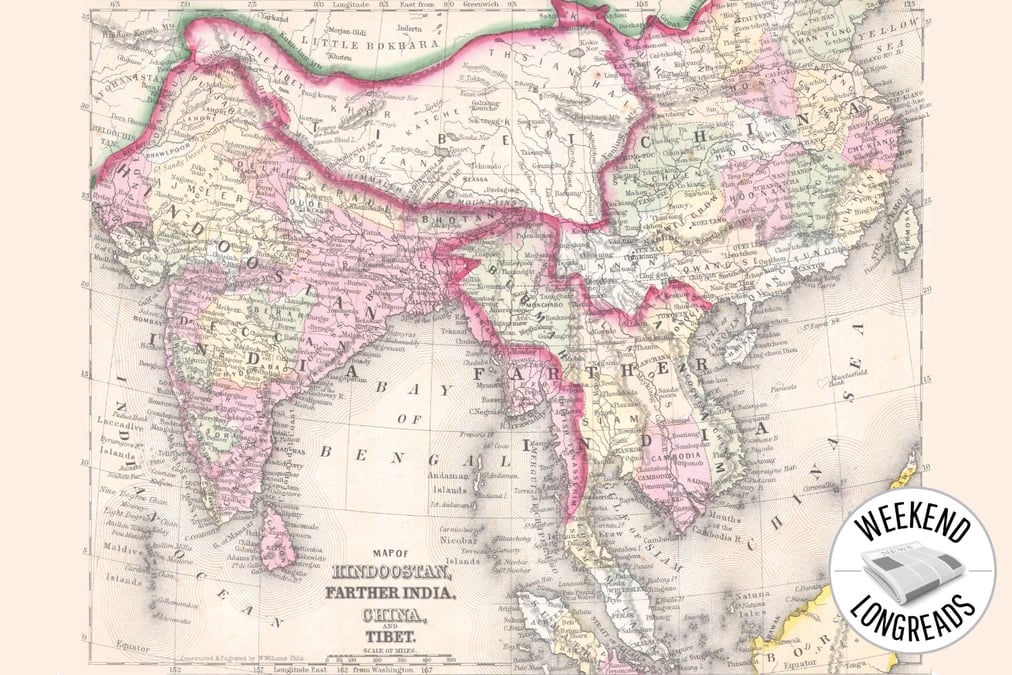
To understand why these gestures resonate so forcefully, one must return to the deeper architecture on which they fall. The subcontinent carries not one historical geography but three. There is the civilisational past: epics, empires, pilgrimage routes, whose outlines stretch far beyond the borders of modern sovereignty. There is the colonial cartography layered atop it, drawn hurriedly and indifferently by men who never intended to inhabit the lands they demarcated. And there is the postcolonial state, fragile in identity and jealous of territory, inheriting maps it never drew and histories it cannot fully escape.