
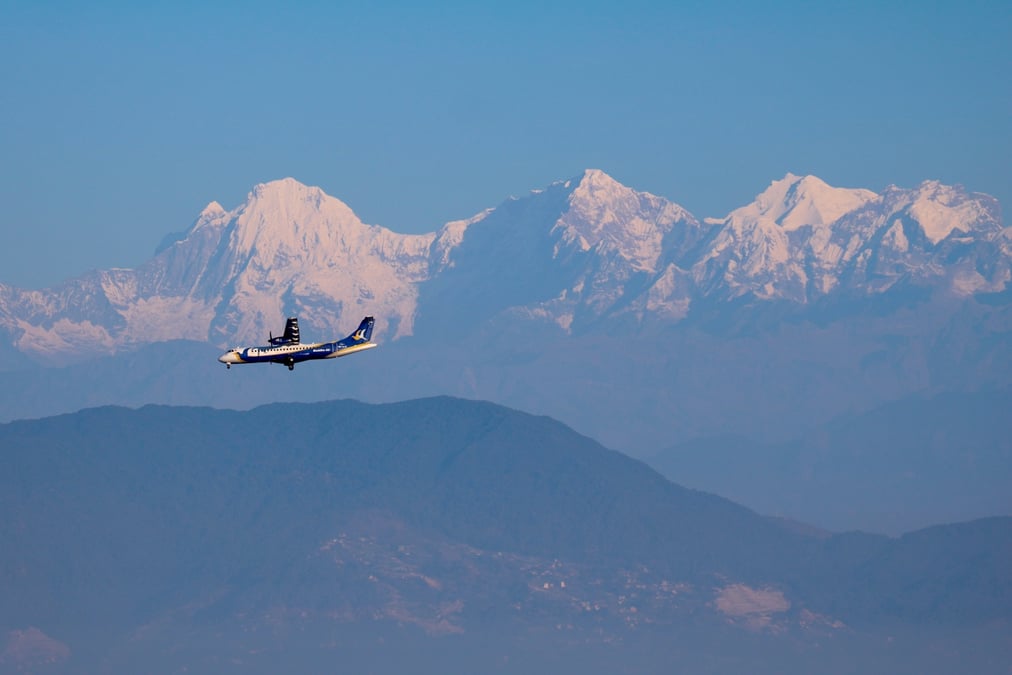
On Saturday afternoon, as storm clouds built up over Central Nepal, three international flights performed Go-arounds at Kathmandu airport.
A Qatar Airways Airbus A330 from Doha, a Boeing 737 Max of FlyDubai and an Indigo Airbus 320 from Delhi. All three reported tail wind and wind shear at the threshold of runway 02.
Nepal’s media characterised these as ‘near-misses’ – as if the planes were almost having a mishap. Actually, a Go-around is very common at airports around the world and shows that the pilots take safety seriously and abort a landing if the approach is not stabilised.
A Go-around is when an aircraft on final approach suddenly climbs again on full power instead of landing and circles around for another attempt. This is a standard safety procedure in aviation, even though it may alarm some passengers. Go-arounds are also called ‘missed approach’ or ‘overshoots’.
The International Air Transport Association (IATA) notes that go-arounds are an important part of flight safety, allowing pilots to avoid potential hazards on the runway, the surrounding airspace, or if there is high wind or poor visibility.
Globally, 3% of all landings by commercial aircraft are Go-arounds, showing how they are common and preventive measures rather than emergency responses.
Pilots usually initiate a Go-around if the approach is unstable due to wind or turbulence. A stable approach means maintaining the correct speed, altitude, and descent rate for a landing. If these factors are not optimal, pilots may opt to go around as a precaution.
Sometimes pilots decide to go around if there is a runway obstruction, which can be another aircraft, vehicle, debris or bird activity on the runway. But the most common reason for planes to go around is weather-related: sudden changes in weather, such as strong crosswinds, heavy rain, or poor visibility.
Kathmandu’s Tribhuvan International Airport is surrounded by high terrain that requires a steeper than usual approach for landing. This time of year, there are high winds especially in the afternoons with cloud-build up and turbulence.