
Even as mayor Balendra Shah was known to be not much of a talker, to have a short fuse, be impulsive, reclusive and reticent. That persona served him well as a do-er, and got him elected to be prime minister.
But 50 days on, the prime minister’s disdain for Parliament by walking out during a speech by President Ram Chandra Poudel, disregard for the international community, and indifference to his own party is starting to tarnish his carefully cultivated cult of personality.
The prime minister had arrived at the joint session of the House on Monday, handed over to President Ram Chandra Poudel the government’s plans and programs and about half an hour later, strode out of the chamber.
To be sure, loyalists on the social web (of which there are many) still admire him as a crusader against corruption, for not meeting foreign emissaries, and for walking out of a joint session of the House. Like populists elsewhere, Balen’s base thinks he can do no wrong.
However, even in the same social media platforms that elevated Balendra Shah to prime ministership, there are now murmurs of dissent about his deafening silence. His enigmatic style is prompting wild conspiracy theories about a possible personality disorder to an authoritarian streak.
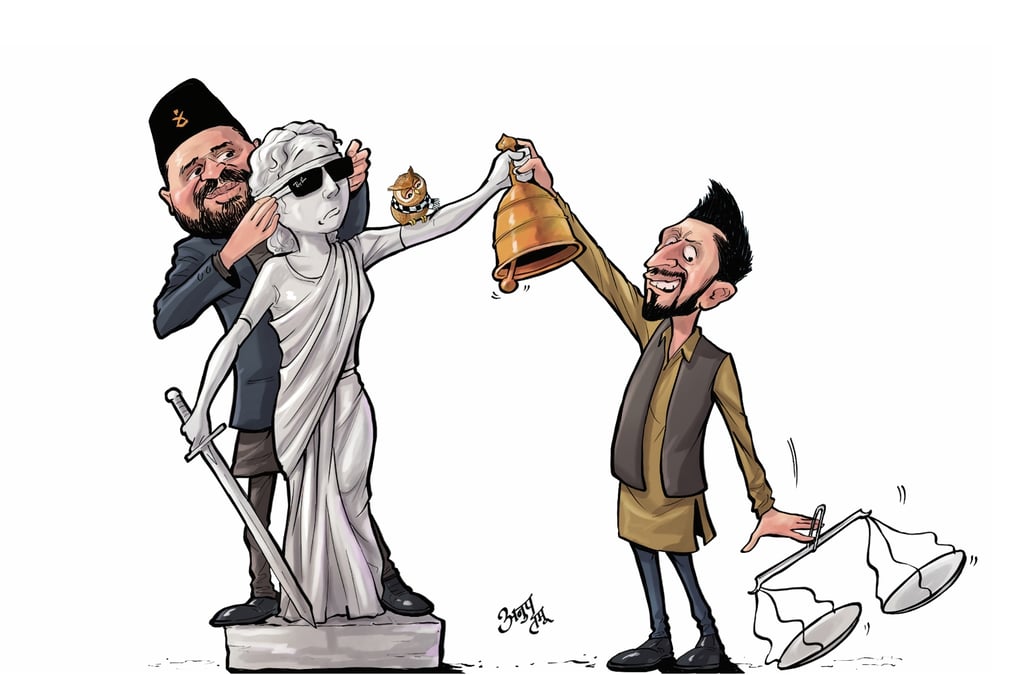
SHADED JUSTICE
On Monday, Parliament convened for the second time since the election. The prime minister last month had the president suspend it so he could pass a slew of ordinances, including one that allowed him to induct a new Chief Justice of his choice.
The RSP’s unique selling point has always been that it is different from the old parties. But the ordinances exposed it as being no different. The mass sacking of 1,500 political appointees, though applauded by some, also raised suspicions that they would be replaced by RSP loyalists.
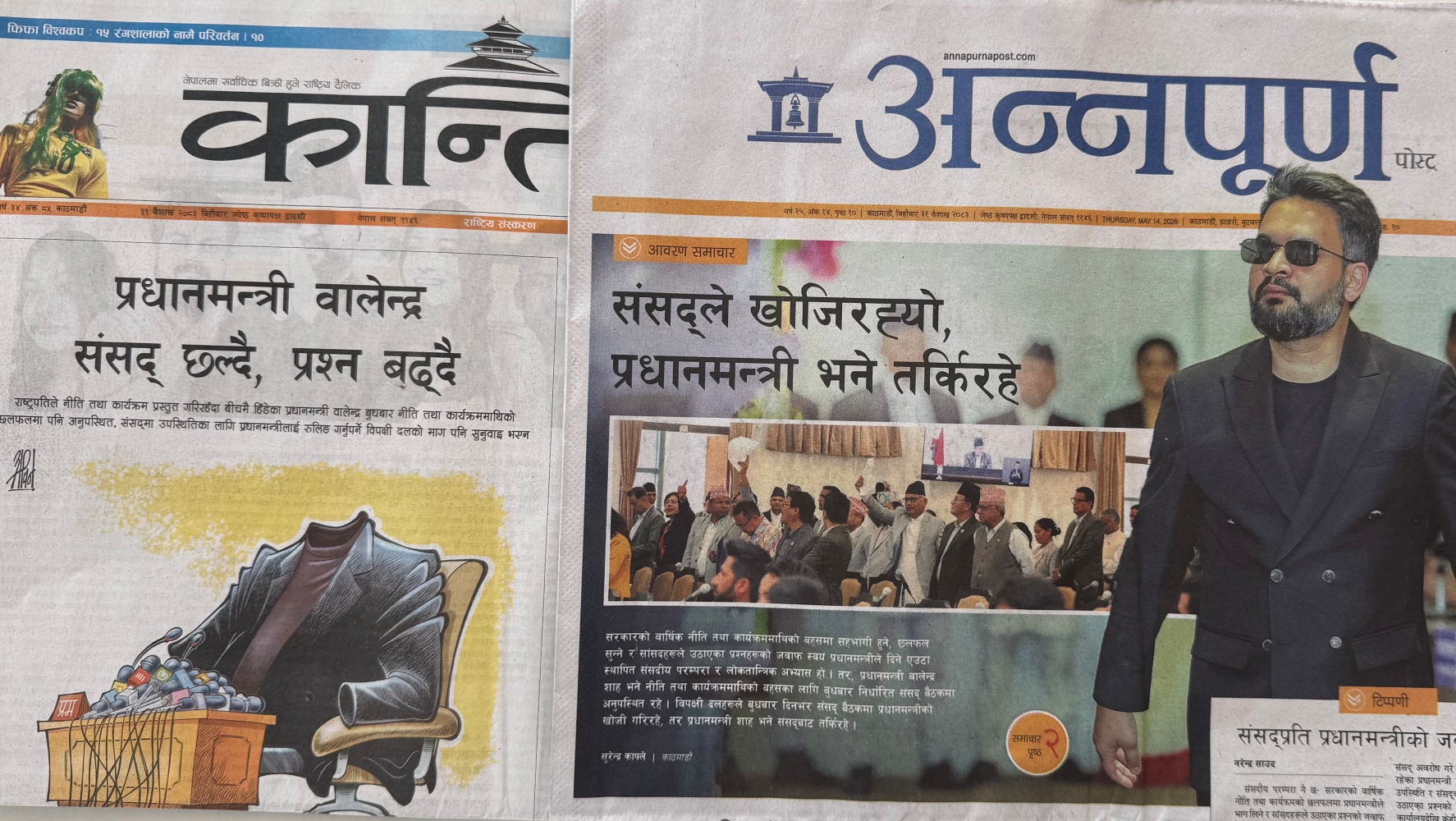
The opposition bench was up in arms against the government’s recent moves on the forced eviction of the landless, the ruling by ordinance, appointment of the new Chief Justice bypassing three seniors, about not being approached to discuss the budget.
Is it the राष्ट्रिय budget, one opposition leader asked, or the Rastriya Swatantra Party budget? Some asked amidst rumours that the draft was being written at the PMO and not at the Finance Ministry. It is being called a ‘Balen Budget’.
On Wednesday, the Prime Minister was scheduled to answer questions in the House about the government’s plans and policies. But at the last minute, he designated Finance Minister Swarnim Wagle on behalf of him to do that job. Wagle was prevented from doing so speak as the House uproar continued.
“The PM’s absence from Parliament is atypical behaviour, and he would do himself a lot of favour by following established democratic practices—but he does not seem inclined to do that,” says political analyst Tula Narayan Shah.
The House was in uproar, and had to be adjourned. MPs from the ruling party including RSP chair Rabi Lamichhane sat stone-faced through it all, even though privately some have started expressing disquiet about their prime minister’s erratic behaviour. The House session opened on Thursday amidst continued protests.
Experts say that from the it looks as though RSP chair and the Prime Minister Shah have an unspoken agreement that while Lamichhane says out of government operations, and Shah stays out of party affairs.
“Democracy is basically process-oriented system, but the RSP is more focused on the result rather less on process,” Shah says.
Bisushi Dhungel of the National Democratic Institute agrees: “The Prime Minister has so far shown little regard for parliamentary processes. Additionally, his administration prioritises the optics of delivery over discussion, messaging this as their top priority.”
Experts note that intra-party conflicts emerge when party leadership and executive leadership are separated, which might happen within RSP, especially as criticism of the government increases and the honeymoon period comes to an end.
“One way populism-leaning governments operate is by amplifying service delivery at the local level to keep the public satisfied and on side, while chipping away at the more theoretical and academic institutional exercises within democratic setups,” says Dhungel. “The details of these exercises only appeal to a small group of democracy activists, practitioners and policy wonks. It's too early to say that is what we are seeing in Nepal, but the signals are clear.”
The prime minister himself does not seem to be affected by all this, sanguine about his vast support on the digital platforms. His action-oriented statesman persona with little patience for the old ways of doing things is still hugely popular.
‘His unspoken message is clear: I do not care what you think of me, because this Parliament cannot tell me how to run the government as long as my following on Facebook remains strong,’ wrote RPP leader Prakash Chandra Lohani.
Adding to speculation about the prime minister’s attitude was his close adviser Asim Shah writing on social media that the prime minister had left the House in a hurry because he was unwell – and then quickly deleting the post. This time, frustration boiled over even among his base. Many pointed out the irony of a figure who had once sung ‘मलाई बोल्न दे सरकार’ in rap to his silence now.
Even so, analysts point out that Nepal’s civil society and media are largely Kathmandu-centered, and they are not pro-RSP, they are associated with the traditional elite. Meanwhile, RSP is an emerging elite with a supporter base of the youth and those outside Kathmandu.
“These people voted for the RSP in hopes that their lives would not be plagued by corruption and daily bureaucratic and governance inconveniences—and they are already seeing those changes on the ground,” notes Shah. “So they are more concerned about service delivery improvement at the grassroots and less so about the parliamentary process.”
Public sentiment and the sentiment of broader civil society are not aligned as we see established and emerging civil society leaders begin to aggressively criticise the government, says Dhungel.
“The idea that not being answerable to 'the public' itself would alone make the PM, his government, and his party unpopular is naive, and as we see worldwide, simply untrue," Dhungel adds. “People in Nepal want to see results-- the problems will intensify if or when this insular way of governing doesn't deliver in the way this administration has hoped.”
RSP lawmaker Manish Jha said last month during the first session of Parliament: “The House is not a public square or tea shop where one can arrive, speak, and leave as they please. It should be a university where we come having done our homework, ready to ask questions, table proposals, and prepared to make presentations. It should be where the people's questions find meaning.’
This week, it seems as though the prime minister who needed to hear Jha’s word the most. But his seat remained empty.