

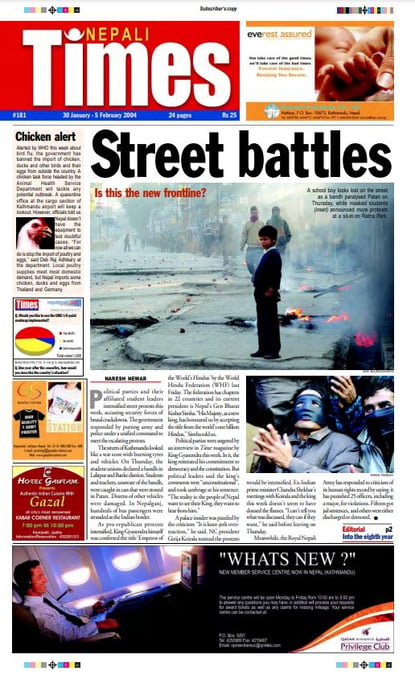
20 years ago this week, the Nepali Times editorial marked the eighth year of the Maoist insurgency and contemplated if it was actually necessary to correct our political system. Nearly three decades after the start of the war, we have asked ourselves the same question.
Certain sections of society are more empowered, there is better inclusion today, but we did not need a violent conflict to achieve them. It certainly was not worth the cost if the current leadership is what it threw up. Excerpt from issue #181 30 January – 5 February 2004:
It is possible that if the Maoist insurgency had not been ignited in February 1996, we would still be mired in corrupt, go-nowhere parliamentary politics. And if our elite and politicians are unable to look beyond their narrow self-interests even when a rebellion is at the gates, maybe they never will.
But it is also quite possible that the distortions of a democratic polity would have worked themselves out and elected representatives at the grassroots (perhaps even some of those who bear arms today) would now be at the frontline of the war on want.
If there had been a momentum for reform from below, it is quite likely that national politicians would have started to behave themselves.
Democracy has a built-in self-cleansing mechanism, a flexibility that brittle authoritarianism lacks. But we will never know. Instead, there is only the certainty that our country is polarised between a hard right and a ruthless left. It's not much of a choice…If there hadn't been a war and if we still had a parliament, we would still need to address the gross inequities in society. It is possible that parliament would be debating political reforms through constitutional changes.
For archived material of Nepali Times of the past 20 years, site search: nepalitimes.com