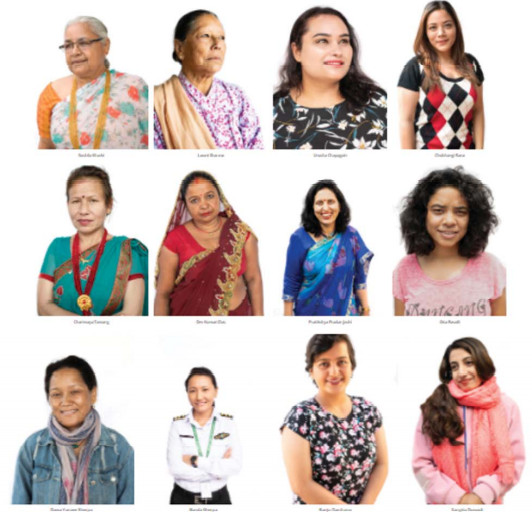
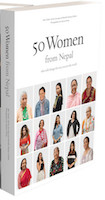
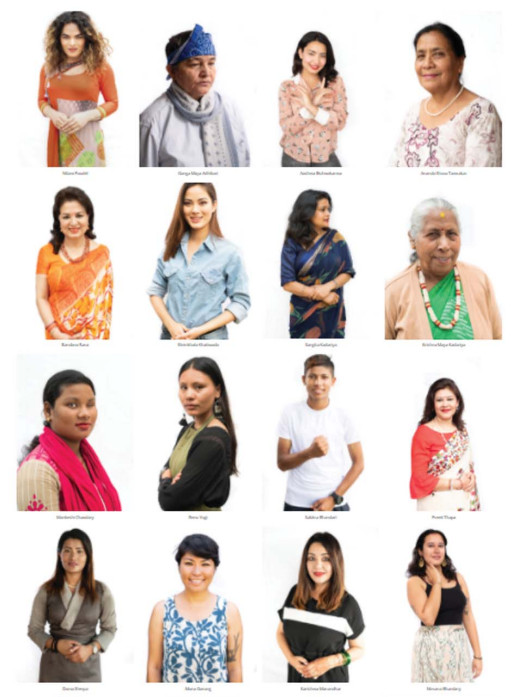
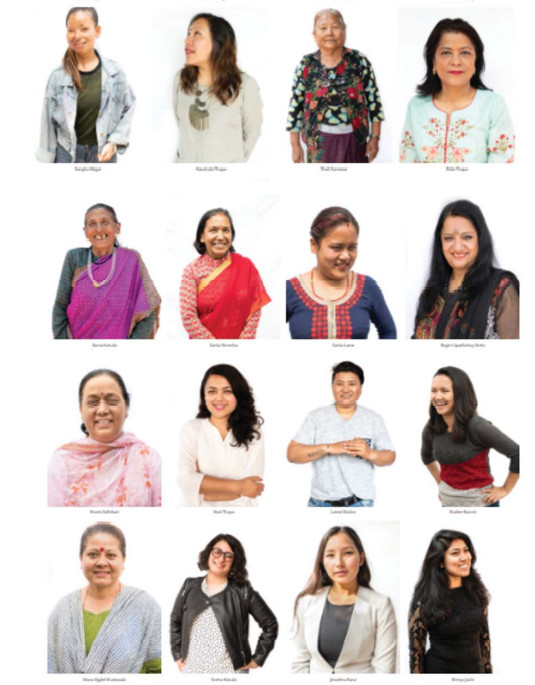
Here is a directory of 50 women from different walks in life in Nepal, a collaborative work by Bec Ordish, Sarita Gurung and Nimdiki Sherpa-Ordish, with photos by Jessica Amity. 50 Women from Nepal comes with the claim to ‘change the way you see the world’, and it might if you give this book a chance.
The authors ask six questions on repeat to 50 women from public and private spheres, some known names and some now known, and many of whom have been profiled in this newspaper over the years.
The questions range from what matters, to their inspirations to the one word that matters, and in answering those six questions, the lives of these 50 Nepali women unfold before us.
Kalpana Pradhan is a mother, and to her being a mother matters the most. Self-educated, she has written over forty children’s books in Nepali. But the life of a writer came to her by fluke when she started writing stories for her own children, none of them written with the intent of a public eye.
The word ‘mother’ is uttered when we hurt, feel surprise or dismay. The term is loaded because of women like Pradhan, who fence their children from the world at crowded fetes in Pashupati. We also know this from Pratikshya Pradhan Joshi, who, as a teacher of Nepali, allows her students to sing and converse and get noisy in their classrooms as they learn, instead of disciplining them— variations of motherhood.
But motherhood is sometimes akin to sisterhood. Gita Rasaili has spent her life dedicating it to fighting for justice for those affected during Nepal’s conflict. Her sister was sexually tortured and killed and as a child soldier herself, she has seen the darkest sides of war.
“My family’s grief changed the direction of my life. It led me to search for answers,” she says in the book.
If ‘voice’ is the most outstanding term for Rasaili, ‘patience’ is what defines Shila Thapa who has devoted herself to caring for children with Down Syndrome, beginning from her own son.
“My biggest fear is what will happen to people with Down Syndrome when their main caregivers die or leave them,” which is what propelled her to set up the Satyam Day Care Centre. She believes everything can be won with patience.
But for some women, it takes more than that. It needs determination. When Sarita Shrestha was turned down by an ayurvedic college saying the course was too rigorous for girls, it only made her more determined. She made sure she would become the first woman in Nepal to have a Doctor of Medicine in Ayurveda. She has toured the world over the years, teaching ayurvedic gynecology, bringing relief to many women going through childbirth.
Dev Kumari Das challenged the tradition of child marriage in her community and has since led a turbulent yet fierce life, even having to physically defend herself against those who do not agree with her. She was literally chained to keep her from fighting against child marriage – a career path that is only rewarded every time she protects a girl from early marriage.
Then there is Ranju Darshana, raised by a single mother she saw politics as the game that would allow her to steer change, a rare career for someone with no oligarchy as backing. A few pages away from her is journalist/mountaineer/comedian Shailee Basnet—laughing the world off in glee.