

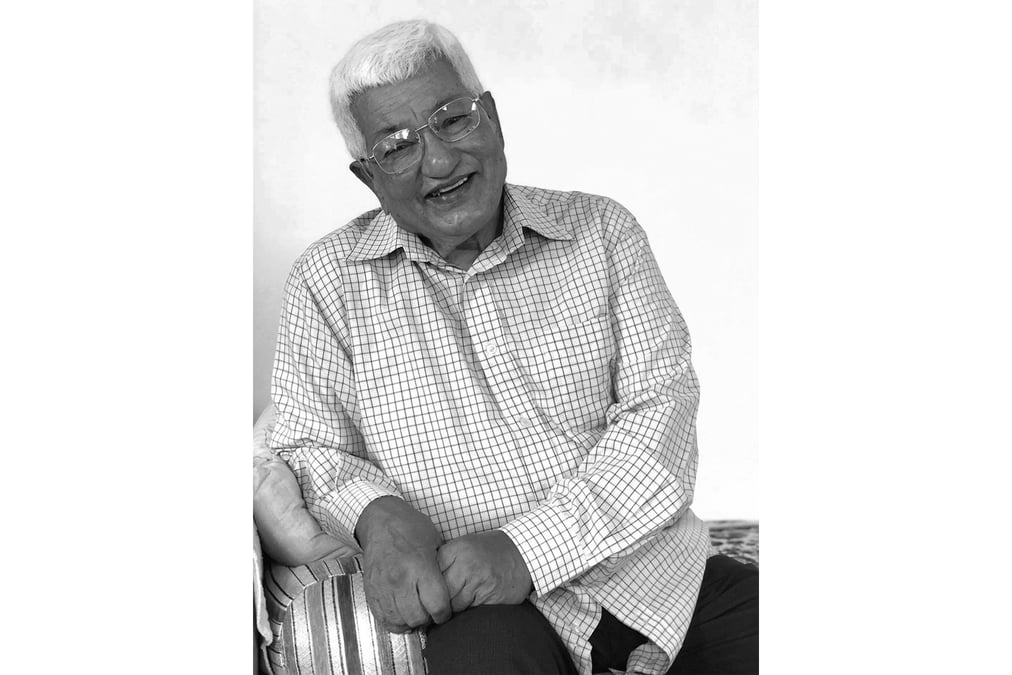
I popped my head inside Musician Nhyoo Bajracharya’s DoReMi Pathshala office to tell him I was done with my lesson for the day—I was leaving.
An elderly man, with a burst of thick gray hair, seated on the sofa inside the office, looked at me and asked, “Cha Uraay ni khaa la?” Are you the daughter of an Uraay?
Nhyoo Sir told him whose daughter I am and then introduced us. The man was Dugalal Shrestha. Poet.
As we connected dots, identified non-familial but social ties, I became adopted instantly. I was asked to sit down. I asked the poet how he could tell I was Uraay and he said the way I speak Newa gives it away. Only a poet who can read the lilt in one’s voice.
I sat there listening to them chat for a while and then left. In the days that followed, if I was in the building, I would always make sure to go into Nhyoo Sir’s office to listen if Durgalal Taaba was visiting. I had learned to call him Taaba quickly. In Nepali Thulo Bua. Someone like a guardian.
Nhyoo Sir would sit there strumming his guitar and Durgalal Taaba would sit near him, weaving words into the music. Sometimes the other way round. Some days, I got to listen to a stanza taking shape and some days, completed songs.
If I was passing through the corridor, and if there was the sound of Nhyoo Sir’s guitar and the voice of Durgalal Taaba, I would always knock and step into the office. I had never before met a man who spoke Newa like Taaba did. I grew up in a Newa-speaking household, where we fling the language at each for its utilitarian purpose, never thinking too much about the way it is spoken. Except when my father sings. But when Taaba spoke, it was something else. He spoke in Poetry.
As a teenager trying to use up my time between schools, I became interested in new hobbies and soon dropped out of DoReMi and so my free sessions with the artists duo was over.
In 2004, my father had a call from Durgalal Shrestha, asking if I would be interested in translating his poems. As a child, like many of us do, I had aspired to write poetry. But at the time, I wasn’t sure if I was qualified to translate his works. Still, the lure of being near the poet made me say yes. And so began a small chapter in my life, when I would go to Durgalal Shrestha’s Thamel home, eat the baji prepared by Taama (his wife), read his poems, listen and translate.
A couple of times, we rode in taxis from Thamel to Tahachal, to Writer and Translator Tirtha Raj Tuladhar’s house, to get help on the accurate interpretation of nuances. An octogenarian then, Tuladhar was beginning to lose focus, as we all do with age. He would grope for the right word in his mind and falter. One time he said: “Durgalal, ji khatam jula,” I’m over.
Taaba told him the words would come back because that is the nature of words. They always find us, he said. I remember that moment like now because there was despair in that moment, but there was also the offering of hope. And it is hope that keeps us still.
I translated 223 of Taaba’s little poems and Poet Rajnimila translated about a hundred. They were eventually edited by DB Gurung and published in the form of a book —a story for another day.
I didn’t see much of Durgalal Taaba after that. I would run into him at events or I meet someone in the family and would inquire after him and that was all.
In 2018 SAFU, together with Srijanalaya and Books for Asia brought out his work Dhapla Khyah, which was when I found myself in touch with his work again. In 2020, his famed song, Phool Ko Aankha ma was released. In 2023, SAFU’s English translation of his work Chiniyamha Kisicha came out. Dhapla Khyah is a lore Newa children grow-up singing, and to see it in the form of a book made my heart jump with joy.
Taaba had always shown Newa-speaking people that it was possible to live with your language. Even at a time when Newa people were taught to be ashamed of their mother tongue and would coat their tongue with the national language.
In the 1990s, a musical album, Chulichiya Chan Chan, a collection of Newa songs for children was released. The songs were written by Durgalal Taaba, tuned by various composers, sung by children. The songs became a gift to Newa-speaking children who had been compelled to listen to songs in languages other than their mother tongue, because no content of that nature had existed before. The songs came to be taught in some schools. One of the songs from the album, Hey Makka, is still hummed by some of my non-Newa friends who went to Rato Bangla School, Lalitpur.
When the album came out, I was in a school run by Anglo-Indians, where I said the Catholic prayer every morning. I had learned propriety. At home, the voices of girls close to my age singing in Newa reverberating through the rooms, gave me reason to laugh. It is curious what joy familiarity can bring! Hey Makka!
I felt the same way again last year, when I was sitting in Durgalal Taaba’s drawing room in his Budanilkantha home. My Baa, my Kaka and I had gone for a visit. We spent an afternoon talking to Taaba, and his son, Suman [uncle]. I listened to them speak—people of letters. Their Newa was deliberate, composed and yet soft and smooth. While I was filled with a tinge of envy for their speaking skills, I also felt a deep sense of connection to my mother tongue.
When we were leaving, Taaba held both my hands and thanked me for the work I had done for him as a teenager. I put my head to his hands and thanked him for trusting me.
I saw Taaba again yesterday. Before him, I saw Taama. Clad in red, as she always is, she was seated outside their bedroom, her feet propped up on a stool, tears streaming down her face. It had been less than 12 hours since Taaba passed away.
The afternoons I had spent with the couple in their Thamel home came to me in flashes. And my last visit to their Budanilkantha home, when she had sat near him, beaming as he conversed with the others. I wondered how her days without him would turn out—her entire life has been about him. When mourners approached, she gasped and said: I didn’t think he would leave me so soon.
I stepped inside their bedroom, where Taaba was now alone, laid on the bed. Taaba and Taama’s bedroom was where I’d also spoken to both of them on a previous visit. But yesterday, it was just Taaba and me. He was lying on the bed, silent, eyes shut, face turned toward the ceiling. The AC had been left on at full blast. His feet were freezing, I touched them with my hands, put my head to them and said: Thank you, Taaba.
And then, goodbye.
Poet Durgalal Shrestha passed away at the age of 93, on the night of 16th August 2026.