
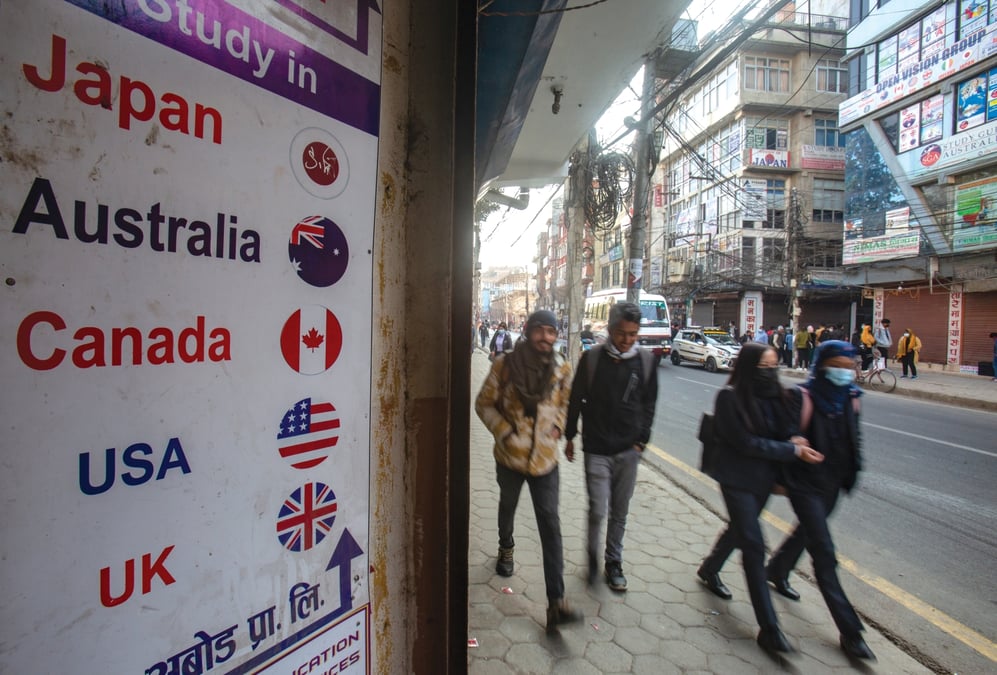
Thousands of Nepali students dreaming of an American education have been forced to look elsewhere as the Trump administration’s visa restrictions make their future uncertain.
The US was long considered a top destination for higher studies, making Nepal the 10th biggest country of origin for international students in America.
However, that number has seen a significant decline with the total for Nepali students now at 16,482. Some 8,000 Nepali students obtained no-objection certificates to study in the US from the Ministry of Education in the past year.
India, Australia, Canada, South Korea, United Kingdom and Japan are the other popular destinations for Nepali students. There are no clear numbers for Nepalis going to India, but a slight decline was noted this year after the deaths of two female students.
The US State Department has issued a circular to its embassies not to issue new visas to applicants until further notice. US Secretary of State Marco Rubio in the directive stated that the department planned to expand the screening of applicants' social media.
While new applicants are barred including those applying for visitor visas, students with scheduled interviews are allowed to proceed.
“Many of our students are affected by the new restrictions, but those who had applied for student visas earlier have got interview dates,” one Kathmandu-based college counsellor told us.
Meanwhile, even foreign students with spotless records already in the US have not been spared, as visa scrutiny intensifies under the new policy. In a move that underscores the growing sense of insecurity, many US colleges advised international students to carry their passports and documents at all times, even when traveling locally.
“Me and my friends did not go home this summer because we were not sure we would be allowed back, so we just went to Niagara Falls,” said a Nepali undergrad in Ohio, who like many interviewed for this report did not want her name used for fear of repercussion.
Nepali students have adopted a cautious stance, with many choosing not to return home during summer vacation due to fear of visa revocations as well as travel bans. Meanwhile, over 7,000 Nepalis with Temporary Protected Status (TPS) will have to come back to Nepal by 5 August or face deportation. Thirty-seven were flown back to Kathmandu on Omni Air last week.
“The US is one of the most sought-after destinations for higher education, and the ban will definitely impact bright students,” says Narottam Aryal of the King’s College in Kathmandu.
Indeed, Nepali undergraduates admitted into Ivy League colleges for the 2025 academic year have been asked to look for alternatives. The entire Fulbright Foreign Scholarships Board resigned on Wednesday citing interference from the Trump administration on the selection of this year’s cohort. Some Nepali students already on Fulbright scholarships have noted disruptions, delays and even cancellation of stipends.
The student visa restrictions were initially just for foreign students admitted to Harvard University, but it was later extended to all Chinese students and now to all students. Universities like Columbia which actively recruit foreign students, face sharp enrolment declines, threatening their financial stability and diversity.
An Indian female PhD candidate at Columbia University had her visa revoked by the US State Department, and said she was targeted on the basis of her social media posts on Israeli military attacks in Gaza. Social media vetting of political activism has raised concerns about privacy and freedom of expression in a country where such rights were a given.