
Given the media industry's short attention span, limited capacity to capture context, and the scripted narrative of international news, reporters cannot be entirely blamed for often superficial coverage of disasters.
Anniversaries are a time to revisit disasters, and the sequel to Nepal's earthquake was written before the reporters arrived -- about non-existent government response, survivors still living in tents, and that none of the $4.1 billion pledged last year has been spent. The truth, as we know, is little more complex. But it would be silly to let facts get in the way of a trending topic.
The coverage of the earthquake is in stark contrast to the Indian blockade, the economic impact of which on the country was much more debilitating than the earthquake. Which begs the question of why the foreign media and a self-righteous international community was conspicuous by its absence. Ditto when the Tarai was burning last August, and when earthquake relief was stuck at the border for five months. And also when the shortage of aviation fuel and diesel halted the distribution of winterisation kits for earthquake shelters. Hospitals ran out of diesel for generators, vaccine cold chains broke down, schools were closed and the country was in the throes of a humanitarian crisis. Foreign media could have made a world of a difference by being there when patients were dying in November-December 2015 because ambulances had run out of fuel. But those were not the ambulances they were chasing.
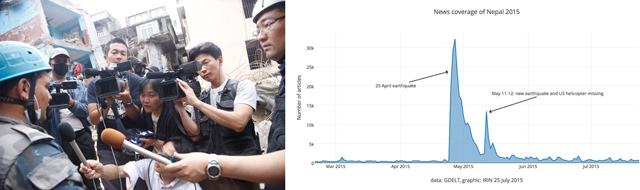
The Google Database of Events Language and Tone (GDELT Project) collaborated with the humanitarian news agency, IRIN to analyse coverage of the earthquake in the first half of 2015, using 300,000 articles in 65 languages that mentioned the word Nepal. There isn’t much interest in Nepal till 25 April (see graph). The interest lasts about a week, there is a small peak on 12 May when a US Marines rescue helicopter disappeared and a smaller blip four days later when the chopper was found in Dolakha.
The GDELT/IRIN study further analyses the 33,000 mentions of Nepal on 25 and 26 April 2015 and found that nearly a quarter of the stories were about the avalanche at Mt Everest Base Camp that killed 16. Predictably, by mid-May coverage of Nepal fell back to nearly pre-earthquake levels even though the actual slow-motion disaster was just beginning in Nepal.
Coverage of the earthquake, especially on tv, zoomed in on what destruction there was, creating the misimpression that Kathmandu had been utterly devastated. Some monuments had collapsed, and those visuals were just too dramatically arresting to resist, but the fact that 90 per cent of the residential buildings in Kathmandu Valley withstood the quake did not fit the prevailing news narrative. Reporters are supposed to strive for accuracy, but disproportionate coverage of destruction in itself distorts the truth. One year later, the world is again fed decontextualised coverage.