
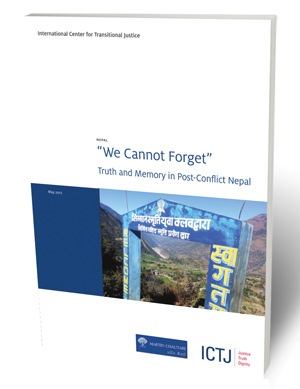
More than 10 years after the end of the Maoist war, the absence of truth has left many Nepalis unable to get on with their lives. A new report titled We Cannot Forget: Truth and Memory in Post-Conflict Nepal tries to illuminate other aspects of the transitional justice process besides the prosecutions – and lack of prosecutions – that sporadically makes news in Kathmandu.
Referring to the dysfunctional truth and disappearance commissions the report says: ‘So far only a relatively narrow constituency of two broadly opposing sides has been involved in debates. Among national and international NGOs, human rights lawyers, and victims’ groups, the dominant discourse has focused on the demand for individual criminal accountability, while government leaders and representatives of the major political parties and security forces have worked to ensure that criminal prosecution and trials are completely off the table.’
Prepared by the International Commission for Transitional Justice (ICTJ and Martin Chautari, the report notes that victims desire truth for various reasons. It says many victims needed closure and an end to the ambiguous loss, others simply wanted acknowledgement of the suffering. Many others seek the truth as a first step towards reparations or criminal prosecutions.
‘Our people will come home today or tomorrow. We watch the roads,’ a woman in Bardiya told interviewers preparing the report.
The wife of a man forcibly disappeared in Jhapa says making his name public would be insufficient: ‘For us this is not enough. It must be proved that someone killed them . . . the killer must also tell where he buried them. For sure the army keeps some kind of recognizable personal things. They must keep their clothes or photo. I will not accept being simply told, “Your husband was killed”.’