
As recent incidents in Nepal and around the world have shown, there is no room for error in the world of aviation. The name of the game is precision and expertise – and that comes with a certified maintenance department and with crew training on ground-based simulators.
Most airlines have their own in-house flight schools, or crew technical departments with sophisticated full flight simulators (FFS) or non-aerodynamic flight training devices (FTD) and flight panel trainers (FPT).
Flight simulators expose flight crew to all in-flight scenarios where pilots can also practice cockpit resource management (CRM) and other replications of real-life situations.
Nepal’s airlines hire pilots who already have a pilot’s license from a flying school abroad, and send them for rigorous simulator training to various centres in Asia or Europe, depending on aircraft type rating. Nepal Airlines, for instance, sent its pilots to Toulouse for conversion from Boeing 757 to A320 and A330, but now conducts mandatory Airbus simulator training in the region.
Buddha Air, Nepal’s leading domestic airline, has in-house flight panel training (FPT) devices at its technical base at Kathmandu Airport, and also sends its pilots for full flight simulator refresher training to France every six months.
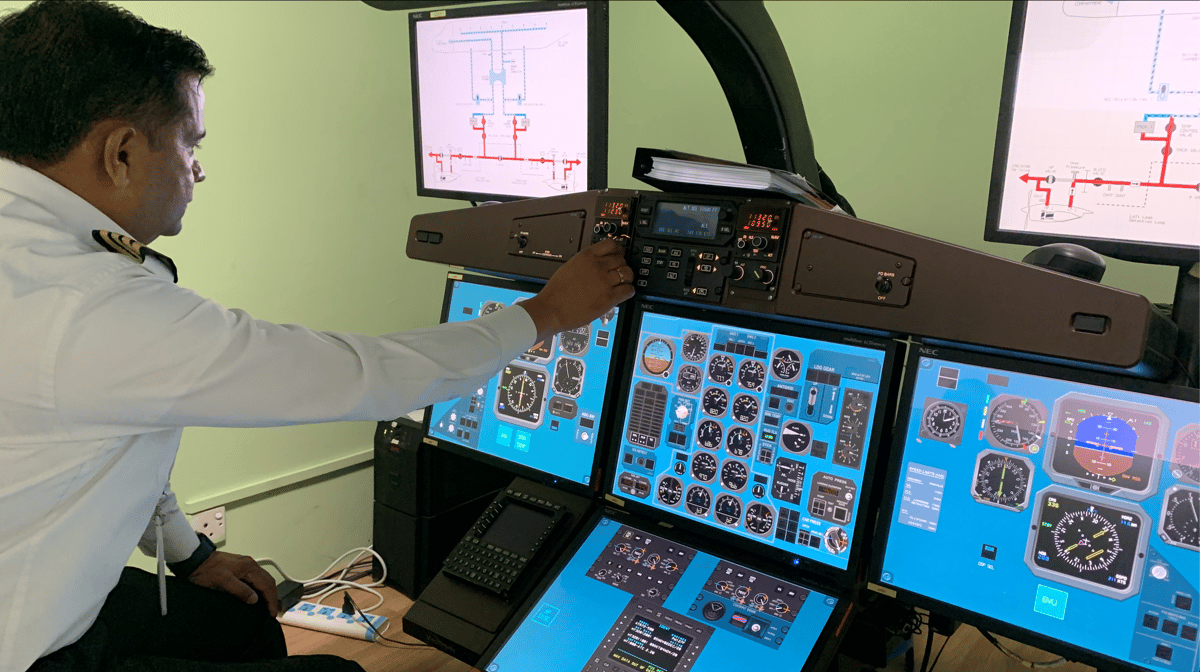
“The ATR FPT is a critical part of our crew proficiency evaluation, and complements the regular full simulator training they do abroad,” says Capt Manoj KC, Buddha Air’s chief instructor pilot with 18,000 hours of flying experience, showing a visitor around the training facility at the Buddha Air hangar.
Flight simulators have become indispensable tools in modern pilot training, offering a realistic and immersive environment where pilots can practice and refine their skills. Simulators replicate the conditions of actual flight, providing a safe space to experience and manage various scenarios, from routine operations to emergencies.
Simulators replicate cockpit instrumentation and controls with precision on high-resolution displays to help pilots develop muscle memory and procedural proficiency essential for effective decision-making during real flights.
Flight simulators are cost-effective because they do not involve actual flying, and therefore cut expenses related to fuel, maintenance, and insurance. By simulating emergency scenarios, pilots are trained to trouble-shoot and handle them without any risk.
Pilots can practice responding to unexpected challenges like system malfunctions, engine failures and adverse weather conditions. With Buddha Air’s flight panel trainers, pilots are also regularly evaluated by an instructor on simulated approach and departures from airports that they are flying for the first time before they perform the actual flight.
“If pilots are flying to unfamiliar airports like Surkhet or Tumlingtar, they train here first, and we can program the FPT to similar various weather conditions and scenarios,” explains Capt Manoj KC.
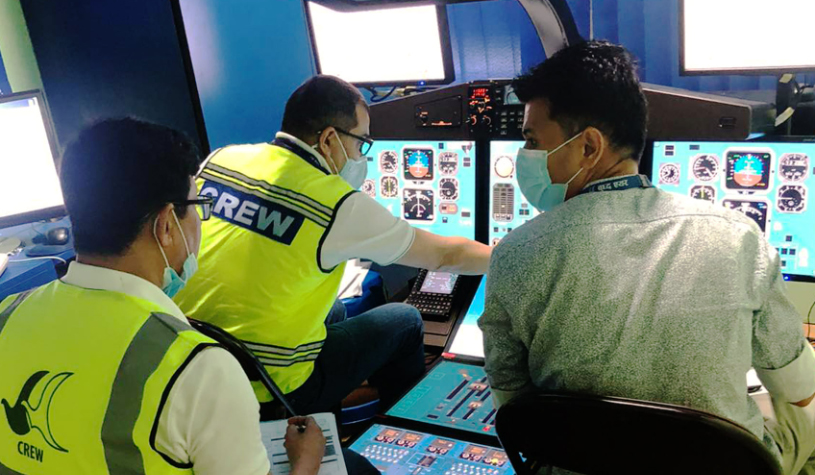
Buddha Air employs the ATR aircraft Flight Panel Trainers for the 150 pilots who fly the airline’s fleet of 18 ATR72-500 and ATR-42s. The FTPs provide a complete platform to refine airmanship, managing flight operations and responding to unforeseen technical challenges during flights. This virtual training tool enables pilots to experience and train for extreme weather, honing their skills and building confidence in handling real-world scenarios.
Equipped with multiple displays, control devices, an audio system for communications, the FPT offers a realistic and immersive training experience and can complete 80% of a Pilot Proficiency Test, and the rest is performed in real flight.
The FTP is a cost-effective alternative, eliminating the financial burden associated with actual flight training, and it also provides a safer learning environment, minimising the risks associated with practicing on actual flights.
The FPT also enables continuous training for experienced pilots, ensuring they remain well-prepared for emergencies and unexpected scenarios. By simulating a wide range of challenging conditions, the FPT helps pilots practice adapting and taking control in difficult, unfamiliar situations, refining their decision-making and emergency response abilities.
This hands-on experience bridges the gap between theoretical knowledge and real-world application, accelerating the learning curve for aspiring pilots and preparing them for the demands of commercial aviation.
The FPT for ATR72-500 aircraft is equipped with realistic avionics, high-resolution multiple-displays that replicate cockpit instrumentation precisely, providing an immersive and realistic training environment.
“The FPT is a convenient in-house system to train new pilots and refresh skills of existing pilots so they can practice and rectify any shortcomings,” says senior Buddha Air captain Shovan Basnet.
The functional controls and interfaces simulate aircraft systems, allowing pilots to practice procedures and manoeuvres with accuracy. The integrated communication systems also enable flight crew to practice radio communication and coordination with air traffic control.
The FPT software processes control inputs, records flight data, and generates detailed performance evaluation and feedback to help pilots identify areas for improvement and skill refinement continuously.
Watch video: https://www.buddhaair.com/videos/simulator-training-buddha-air