
 KIRAN PANDAY |
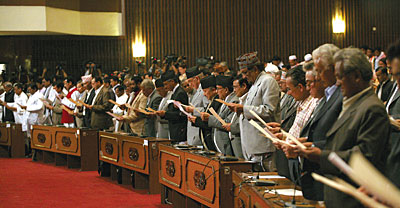
The political parties promised those who voted for them in the CA elections a new constitution in two years. While they have not admitted it publicly, they have implied that a delay is now inevitable.
The CA was not completely passive. The draft committees have already submitted draft and concept papers to the Constitutional Committee. But the drafts are full of contentious issues, as the parties are pushing their own agendas. Ethnic issues have held back the discussions on state restructuring, and there are disagreements regarding the forms of governance, parliamentary system, electoral system, and judicial system.
The CA worked as parliament as well, and the Maoists, having emerged as the largest party, formed a coalition government. But their unilateral decisions led to the fall of their government after nine months. They launched protest programs in the name of civilian supremacy and national independence to get back into power, and warned of a people's revolt. But since the protests failed to bring about an outcome, they pushed their agenda through the CA. This is why the Constitutional Committee received draft papers from drafting committees that had over 100 unresolved issues in them.
The political parties have proved that they preferred power to the constitution. They will now be forced to reflect on the consequences of not completing the constitution on time. The Maoists will be largely responsible for any delay in writing the constitution, but this is not so say the other political parties are less culpable.
The constitution, once completed, has to be passed by two thirds of the CA. This is possible only if all parties work together.
The political parties other than the Maoists should sort out their disagreements, then initiate dialogue with the Maoists on the constitution. Given the national and international context, the Maoists should be flexible or the constitution-writing process will not move ahead.