
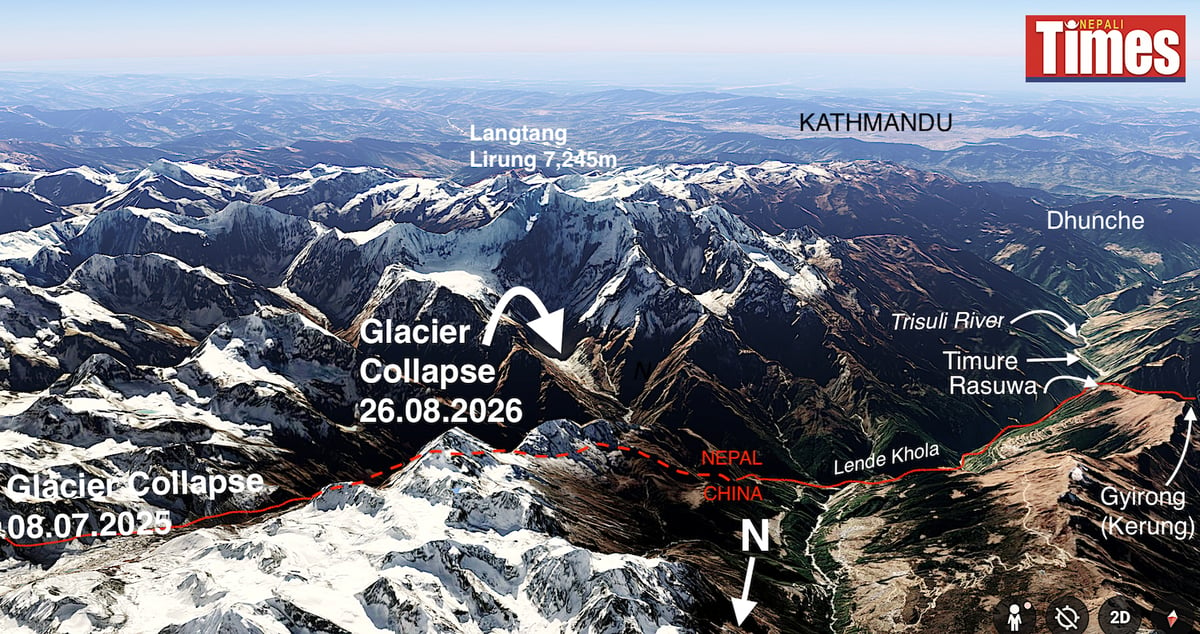
Mt Langtang Lirung, the majestic mountain that towers 7,245m and is located 45km directly north of Kathmandu, has a tragic history.
A massive 7.8 magnitude earthquake in April 2015 that shook central Nepal triggered an avalanche on its south face, which fell into the glacier below and buried the village of Langtang. At least 300 people were killed.
On Wednesday, there was a 4.4 magnitude earthquake near the border with China at exactly 8:37 AM Nepal Time. This time, it coincided with a huge avalanche on the north face of Langtang.
Langtang Lirung is wholly within Nepal, and the debris flow from the avalanche blocked the monsoon-swollen Lhende Khola that marks the border with China. The impounded lake burst soon after, sending a wall of mud and boulders racing down the Trisuli River into Nepal.
At least that is what experts who have seen satellite images from Planet Labs have concluded. Scientists are still divided about whether the earthquake caused the slope collapse on the north face, or whether the avalanche was so massive that it caused the seismic event.
If the tremor was the trigger, it shook a mountain on which the snow and ice was already unstable due to global warming. Furthermore, it happened during the tail end of the monsoon when the slopes were heavy with snow, and the moraines left behind by glacial retreat that used to be bound tightly by permafrost was already saturated with water.
Even though this particular disaster seems to have originated on a glacier within Nepal, it exposes the increasing long-term threat of glacial lake outburst floods, permafrost melting and moraine collapses causing transboundary disasters from the Tibetan Plateau.
Even without an earthquake trigger, there have been a series of recent Himalayan tsunamis caused by a combination of these same factors: Chamoli 2021, Melamchi 2021, Sikkim 2023, Thame 2024, Bhote Kosi 2025, and now 2026. Nearly all of these happened during the monsoon.
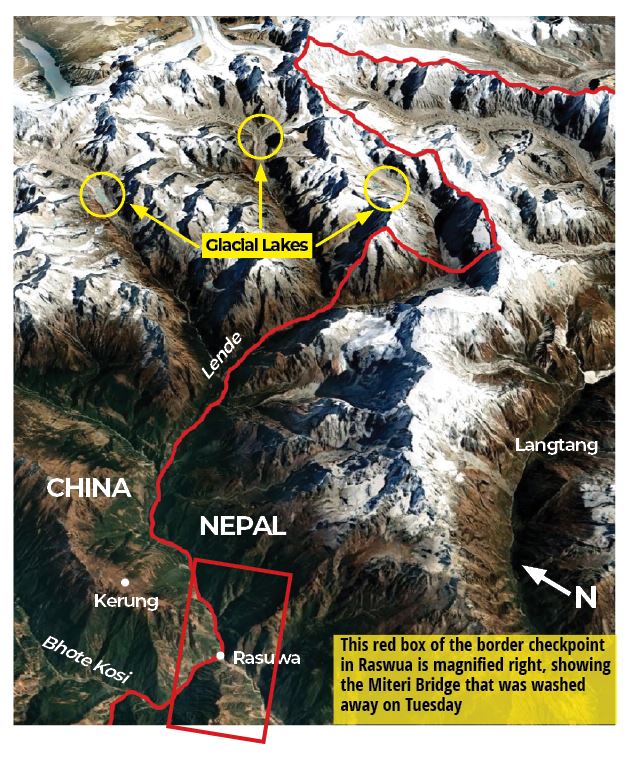
Last year’s flood on 8 July (map, left) killed 18 people, washing the most important Nepal-China border checkpoint for trade and tourism, and destroyed highways, hydroelectric plants and transmission lines in Nepal that had just started to be repaired.
Scientists traced the origin of that flood to enlarged supraglacial ponds coalescing and bursting and sending the wall of debris downstream. Last year, the Chinese side is reported to have warned local authorities in Nepal of the danger. This year there was no warning at all.
Also, the avalanche and origin of the flood was much closer to the border it would have been only a matter of minutes before the debris flow reached the Rasuwa checkpoint.
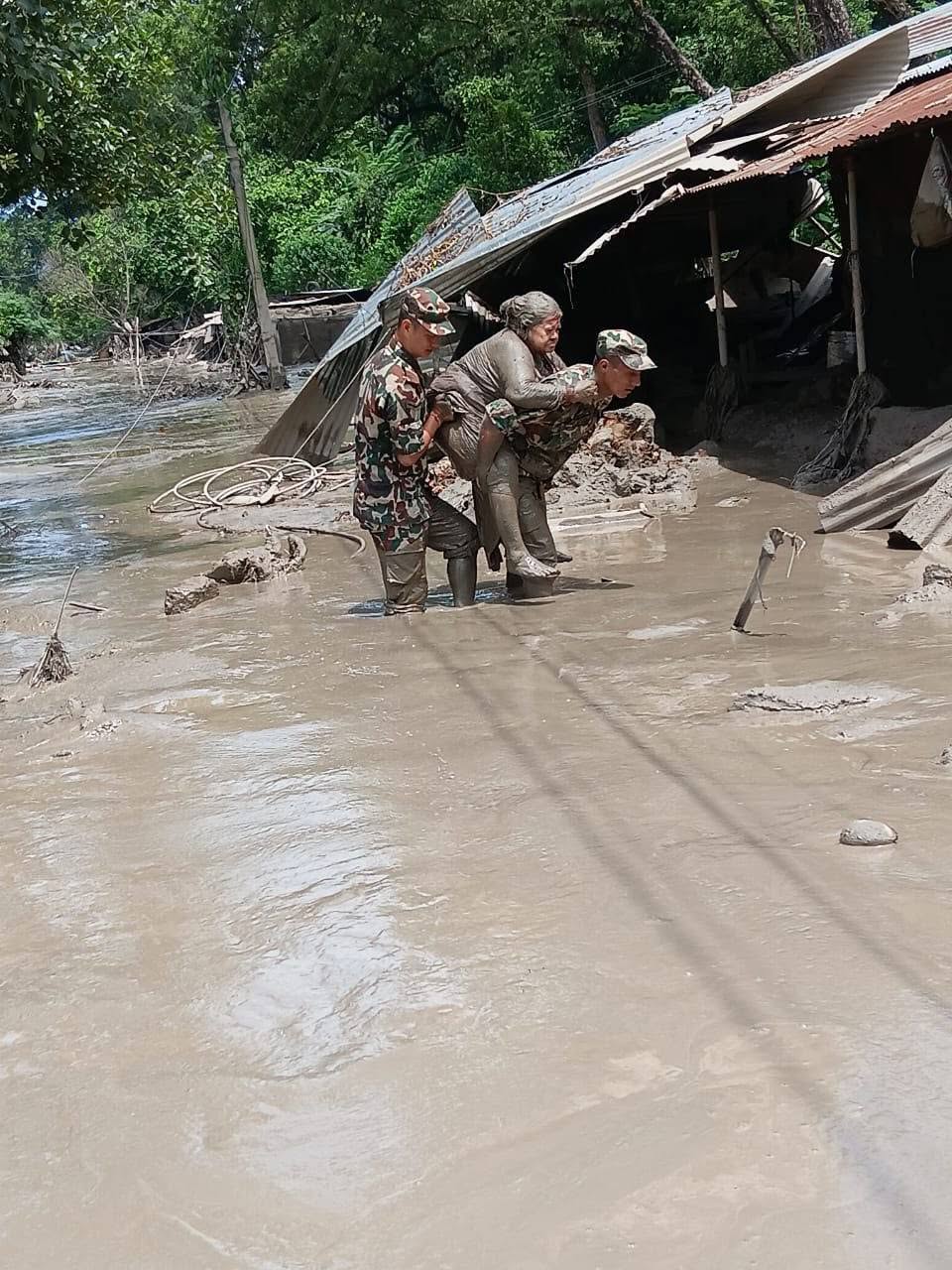
By Thursday morning the official death toll was climbing past 160, and is expected to number in the hundreds. Overnight, human bodies, animal carcasses and debris were seen floating down the Narayani River, 200km downstream in Nawalparasi district.
This disaster will bring up the issue of Loss and Damage that Nepal has been raising in international climate negotiations regarding the economic impact of the climate crisis especially in vulnerable mountain countries. The loss to infrastructure and property will be in the billions of dollars.
In a matter of minutes, at least six major hydropower plants, transmission lines and electric substations on the Bhote Kosi and Trisuli were either destroyed or heavily damaged. Nepal’s showcase 25 megawatt grid-scale solar generation plant in Nuwakot was buried in sediment.
Other under-construction projects also suffered catastrophic damage. At least a dozen bridges across the Bhote Kosi and Trisuli, some of them 70km downstream, have been swept away, cutting off highways leading north.
The disaster has hit Nepal almost exactly a year after the GenZ protests in September 2025 forced early elections, which Prime Minister Balendra Shah’s RSP swept in a landslide victory. His government has been in power less than six months, and now faces the challenge of immediate search and rescue, and rehabilitation along the ravaged Trisuli Valley.
In the longer term, Nepal will need to have an effective strategy to deal with seismic and climate change-induced disasters that are almost certainly going to increase in future.
UPDATE
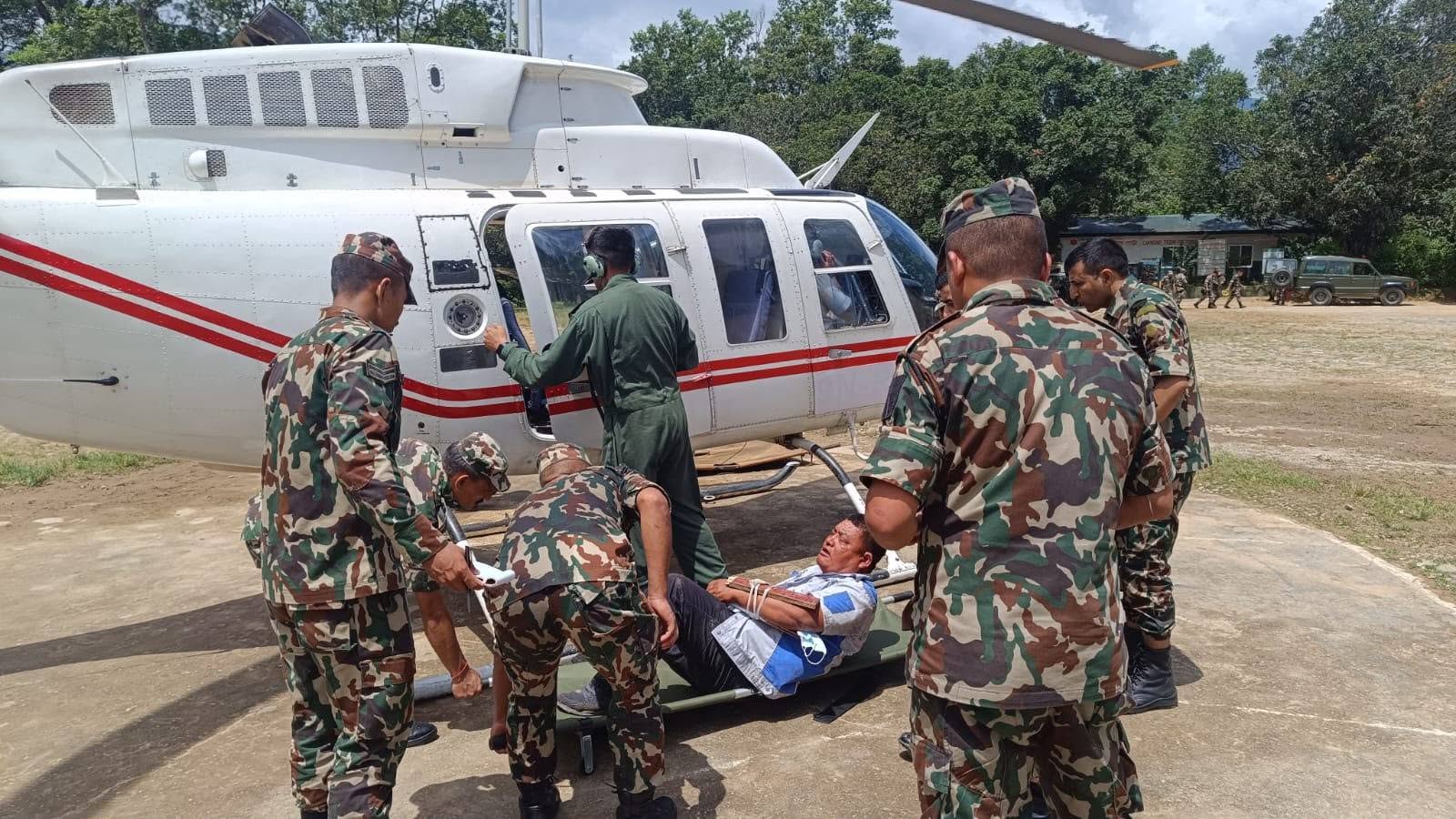
The scale of the disaster is so vast that local governments have been unable to give an estimate about the number of casualties. Entire neighbourhoods in Syaprubesi, Betrawati, Trisuli and other riverside towns have been wiped off the map.
So far, the only figures are for bodies recovered, and that had exceeded 300 on Thursday. Hundreds are still missing, and tens of thousands have been made homeless.
Prime Minister Balendra Shah made a brief helicopter visit to Trisuli, and Finance Minister Swarnim Wagle is leading the coordination of relief.
The Trisuli flood hit at the beginning of the trekking season in Nepal, the peak season for tourism in Tibet and two days before the auspicious full moon day for pilgrimage.
28 August is auspicious for both Hindus, Buddhists and those who follow the animist faith, and thousands had been on their way to Gosainkunda lake in Rasuwa. There were also Indian pilgrims on their way to Mansarovar in China, and they were entering through the checkpoint in Rasuwa-Kerung.
In addition, there were hundreds of tourists visiting Tibet overland. The monsoon is the peak season for visiting the plateau which is in the rainshadow.
Nepal Tourism Board (NTB) says 644 tourists who were in the area are out of contact. This does not mean that they were affected by the disaster, but simply may not have a mobile connection. It is not clear whether among them are tourists who have already entered China and are on their tours. Because social media platforms are not accessible in China, they may be out of contact.
The NTB’s list includes the following nationalities and their numbers:
India: 178 | Nepali: 127 | United States: 65 | Ukraine: 53
Malaysia: 51 | Australia: 35 | UK: 33 | Canada: 25 | Singapore: 9
Russia: 8 | Germany: 8 | Latvia: 6 | South Africa: 6
If you are looking to support communities affected by the flood in Nepal, donate to the Prime Minister's Disaster Relief Fund here. Additional information here.