
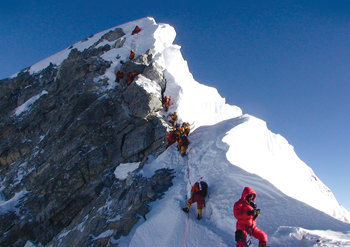
The vertical section on the South-east Ridge just below the summit called the Hillary Step (pictured) represented the last obstacle for mountaineers before they got to the top. But as the Earth warmed up due to climate change in the last 60 years, the Hillary Step today is mostly crumbling rock.
“The Hillary Step and the traverse to it from the South Summit were almost entirely snow climbs with very little exposed rock,” says David Breashears, American climber and filmmaker. “Now our crampons scrape and scratch across hundreds of feet of exposed rock and the snow arête that Hillary climbed no longer exists.”
Breashears, who has been documenting the effect of climate change on the Himalayan permafrost through before and after pictures, says he has seen changes even during the five times that he has climbed Everest. (read the interview here).
As Nepal marks the 60th anniversary of the first ascent of Mt Everest, and making it to the summit becomes almost routine, the thrill of exploration has turned to worry about what we are doing to the planet. As with the Arctic Ice Cap and Greenland, the Third Pole (as the Himalaya is known) is also melting dramatically.
This year’s spring climbing season on Mt Everest has witnessed even more records being broken. The first Saudi and Pakistani woman to get to the top, the first Arab Sheikh on the summit, the first person with no hands to climb, the first Nepali actress on top, and even the highest ever brawl in the world.
However, the real record is the record melting on the flanks of the world’s highest mountain. By all accounts, the melting ice has exposed rock outcrops making climbs more dangerous. It has also made it more scary as the corpses of dead climbers emerge from the thawing ice. In the spring of 2011, Apa Sherpa set foot on the summit of Mt Everest for the 21st time breaking his own record. He says: “In the years from my first ascent in 1990, I have seen the snow cover melting. Where there used to be ice slopes, there is now only rocks.”