
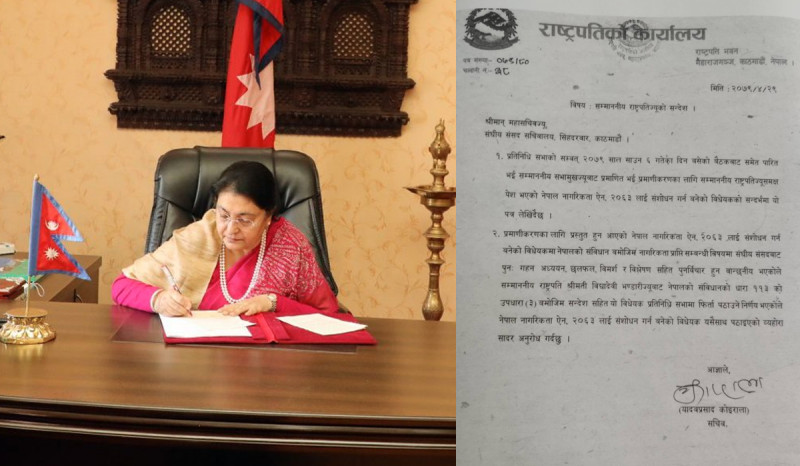
The House of Representatives is set to pass an amendment bill to the Citizenship Act of 2014 after President Bidya Devi Bhandari earlier this week returned it for a review along with a 15-point message.
This is the first time the President has sent back a bill passed by both Houses since Nepal adopted a federal Constitution in 2015. She was using a constitutional provision that the President can ratify a bill passed by both Houses of Parliament within 15 days, or send it back for reconsideration.
As per Article 113(3) of the Constitution, the President can send bills except one concerning financial matters submitted for ratification to the respective Houses for review.
“The Constitution has given the President the authority,” says constitutional expert Bipin Adhikari. “Now Parliament must seriously deliberate on the 15-points sent forward by the President.”
In her nine-page message, the President raised concerns over the provision of self-declaration, the right to privacy, and dignity of mothers. The document also says that there needs to be a historical overview of the drafting processes of the citizenship law, and has requested a detailed study before amending the law.
President Bhandari also suggested discussing the report presented by the State Affairs Committee of Parliament before passing the amendment, pointing out the need for a long-term solution to the controversial issue of naturalised citizenship.
According to Article 304 of the Constitution, the acts and regulations that are in conflict with the current Constitution became invalid after 18 September 2016. But it was not until this year that the government started working on the amendment to the Nepal Citizenship Act 2014.
Seven years after the promulgation of the Constitution, Minister of Home Affairs Bal Krishna Khand registered the draft Bill in Parliament and it was passed by both Houses less than a month later. The debate on a serious issue like citizenship did not even last three weeks, and House Speaker Agni Sapkota did not think it necessary to send the bill to the parliamentary committee for discussion.
Experts say Speaker Sapkota forgot his constitutional role and simply followed the instructions of his bosses in the Maoist party and other leaders of the ruling coalition. Earlier this year, Sapkota had not allowed the US funded Millennium Challenge Corporation (MCC) compact to be presented in the House until Maoist Chair Pushpa Kamal Dahal gave the go-ahead. The Citizenship Bill too seems to have been passed after he got his party’s green light.
“It was wrong to fast track a subject like citizenship,” says Adhikari. “If it had been sent to the parliamentary committee there would have been enough discussion. It isn’t something that should have been passed without proper discussion.”
According to Adhikari, the President returned the Bill after consultations with the Prime Minister, providing an opportunity for the much-needed discussion. The matter is complicated because the coalition partners see President Bhandari as being close to former prime minister K P Oli of the opposition UML.