
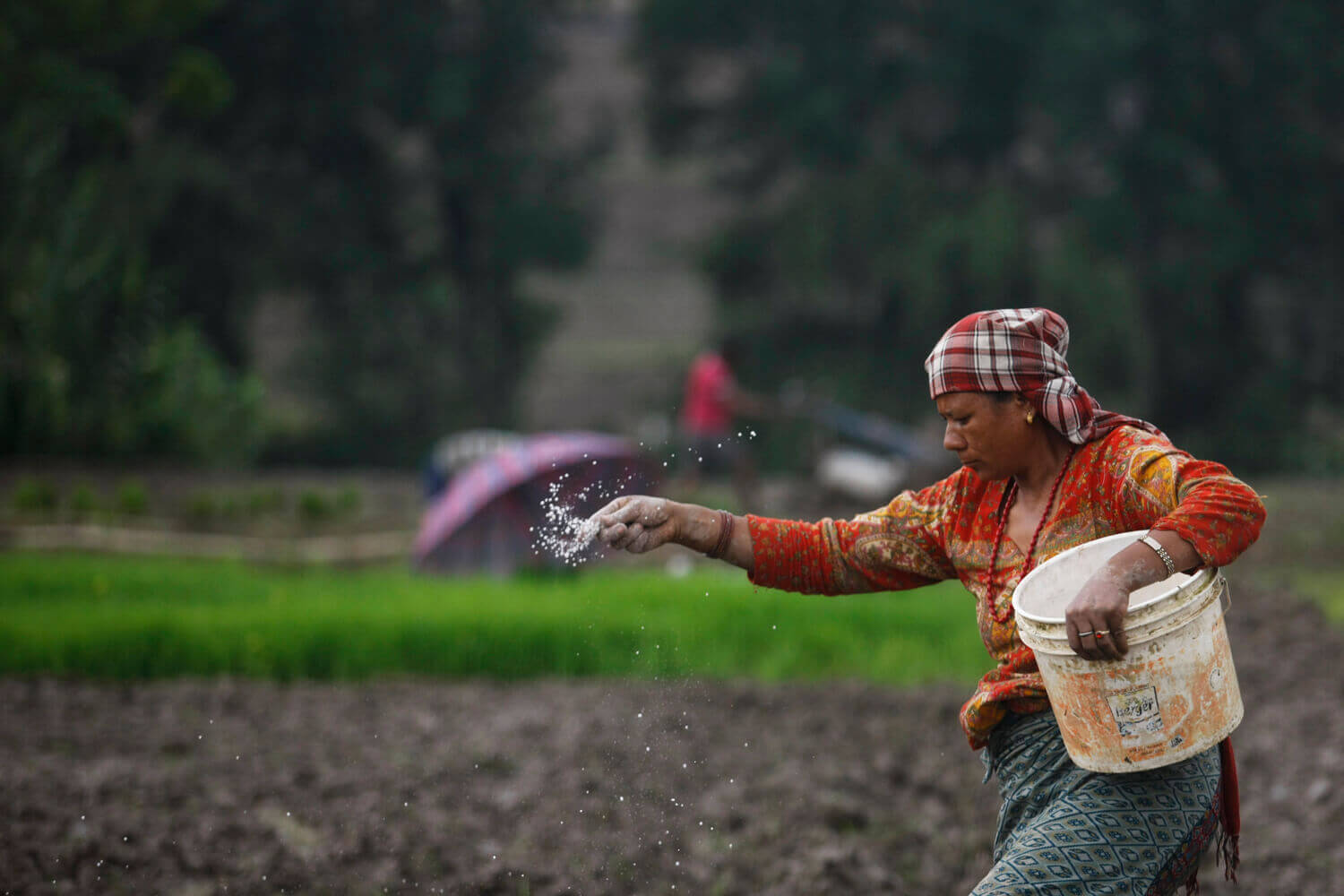
It is nothing new that Nepal’s farmers this year faced an acute fertiliser shortage. That there were kickbacks involved is also not a revelation. This will not be the first time there is a paddy production shortfall because of the lack of fertiliser.
More importantly, it is bound to happen again next year because there is no political will to tackle the root of the problem -- collusion between government officials and their cronies to siphon the allocated budget and profit from payoffs.
This year, the companies hired to import fertiliser, Shailung Enterprises and Honiko Multiple, defaulted on their contracts, citing the lockdown as an excuse. That the powerful owner of one of these companies is the landlord of NCP chair Pushpa Kamal Dahal has not gone unnoticed.
Rise of rice in Nepal, Krishna Dev Joshi and Santosh Upadhyay
Nepal agro imports all time high, Ramesh Kumar
Last week, the Patan High Court stayed an order by the government’s Agriculture Inputs Company Limited (AICL) to confiscate the Rs50 million deposit of Shailung and Honiko for failing to supply imported urea in time.
Despite a healthy monsoon this year, Nepal’s rice production is not expected to rise because the consignment of chemical fertiliser did not arrive at the start of the paddy season. India has frozen export of fertiliser, and Prime Minister K P Oli made an SOS call to Bangladesh Presient Sheikh Hasina on 1 September to “loan” Nepal 50,000 tons of fertiliser.
By the time the fertiliser arrives, the rice will be ready for harvest. Besides, Nepal’s annual fertiliser demand is up to 800,000 tons. Failure to apply urea layering on time worried farmers across the country as the transplanted paddy fields did not receive required nutrients.
Critics say the lockdown is not an excuse. Because after March, the government made no visible effort to have the consignment released from Kolkata’s customs warehouse, did not have adequate buffer stock, and failed to line up alternative sources in time for paddy transplanting in late June. Farmers therefore crowded fertiliser distribution centres for the limited supplies available, risking Covid-19 infection.
Back to the future of farming, Editorial
Despite lofty promises made by the ruling Nepal Communist Party (NCP) to aim for agriculture self-sufficiency, the fertiliser scandal tells a different story. Nepal’s chemical fertiliser output is negligible, leaving it completely reliant on imports, mostly from India.
The government’s singular focus on chemical fertiliser also means that alternatives with organic nutrients have been side-lined (see box, below). Farmers are trapped because they have abandoned traditional seeds for imported hybrids which require chemical inputs to yield optimum harvest.
The Covid-19 crisis has exposed this alarming reliance on imported chemical fertiliser, and Nepal’s inability to manufacture its own. This week, a Parliament committee instructed the government to set up plants to make Nepal self-sufficient in urea.
However, feasibility studies carried out by the Investment Board Nepal with Infrastructure Development Corporation Karnataka (IDECK) show that Nepal’s domestic demand does not have the economy of scale to produce fertiliser. A third-party evaluation of the IDECK report led by Dil Bahadur Gurung calculated that it would cost upwards of Rs72 billion to set up even a small fertiliser factory.
“The reliance on natural gas piped from India or Bangladesh to these factories would add to the cost, and it would be viable only if it could produce up to 2 million tons of fertiliser a year,” says Gurung. However, talks with Bangladesh and China regarding natural gas pipelines broke down, while a proposed pipeline from Gorakhpur in India has been sidelined due to frosty bilateral relations.
Using electricity to fix nitrogen from the air will be even costlier, with estimates to set up such factories tagged at upwards of Rs144 billion. It would need a new hydropower plant dedicated just to supply the fertiliser factory.