

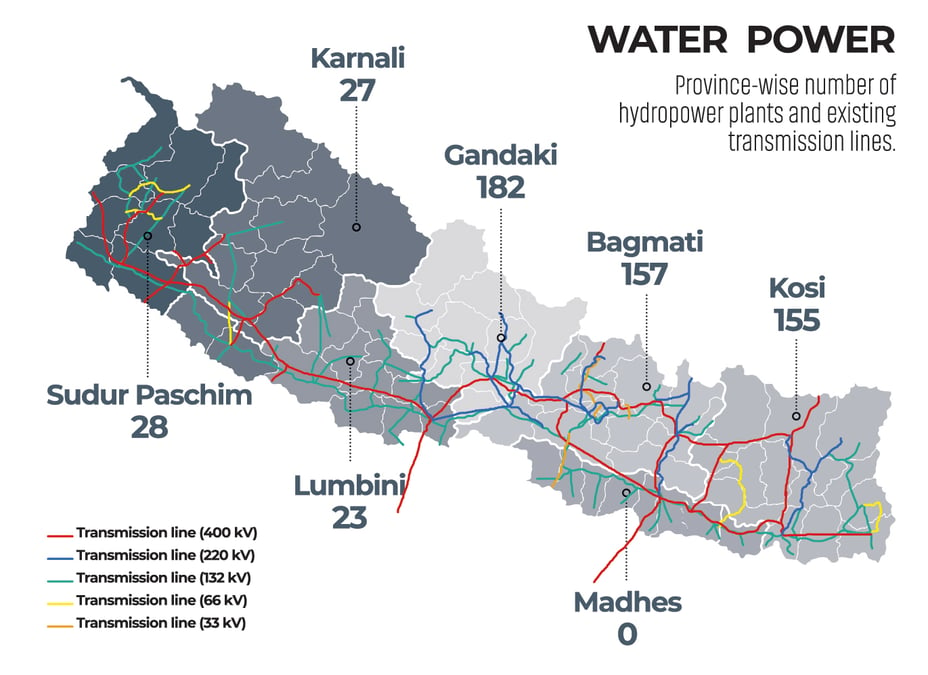
Nepal’s national electricity grid is supplied with power from a remarkably decentralised array of 162 hydropower projects and 14 solar photovoltaic schemes spread across 43 districts, supplying power over the grid to 30 million people.
Another 249 hydropower projects and 14 solar projects are at different stages of construction, positioning 11 new districts to contribute power to the grid by 2030. Six of the country’s seven provinces generate hydropower as their main energy source, while Madhes Province generates solar energy.
While NEA (Nepal Electricity Authority) and its subsidiaries own and operate 20 generation stations, the remaining are owned and operated by Independent Power Producers (IPP). All but two of the IPPs are Nepali companies that have successfully mobilised over $2 billion in investment.
This investment has been spread widely across the country. Eleven districts generate more than 100MW each with Dolakha, Lamjung, Solukhumbu, and Ramechhap each exceeding 200MW (map). The average size of hydropower projects on Nepal’s grid is 15.5MW, while the average solar project is 4.2MW.
The average size of projects under construction is larger -- 39.5MW for hydro and 6.9MW for solar respectively.
For most hill and mountain districts, hydropower is easily the largest investment, private or public, in their history.
This decentralised power generation model is a relatively recent development for Nepal. In 1995 when the World Bank withdrew (adjoining article) its planned investment from the 201MW Arun III project, NEA had not envisioned the entry of the private sector. In fact, its published strategy was to mobilise international aid for hydropower projects larger than Arun III.
The well-known cancellation of Arun III in 1995 and the availability of alternative models led to Nepal's decentralised power development. It matters that this distributed generation and storage of electricity is close to the point of use.
Centralised power stations have been the norm for industrialised and emerging economies to achieve rapid and cheap electrification, taking advantage of economies of scale of large power plants.
Also in Nepal, when its vast hydropower potential was first quantified in the 1960s, plans were drawn up for mega hydropower projects with reservoirs such as Karnali, Kosi, and Pancheswar. None of these could be realised, however, due to lack of financing.
Donor funds could never be aggregated at the scale needed for the investments required, and the country was not attractive to the international private sector. Nepal opted not to invite India to construct its large hydropower projects to supply the Indian market the way Bhutan did.
It took the country 40 years to find its way -- generation led by private domestic investment supplemented by public sector involvement by the NEA.
The cancellation of Arun III resulted in the government signing expensive dollar-denominated power purchase agreements (PPA) with international producers like Khimti (60MW) and Bhote Kosi (45MW) to partially make up for the shortfall. These were against the wishes of NEA management.
It was in reaction to these expensive PPAs that engineers at NEA received permission to develop Chilime (20MW) with rupee-denominated PPA and the government at the time announced a standard tariff in NPR for power generated by IPPs.
Once NEA showed its willingness to sign these PPAs, hundreds of companies sprang up to apply for licenses to survey and construct small hydropower plants throughout the country.