
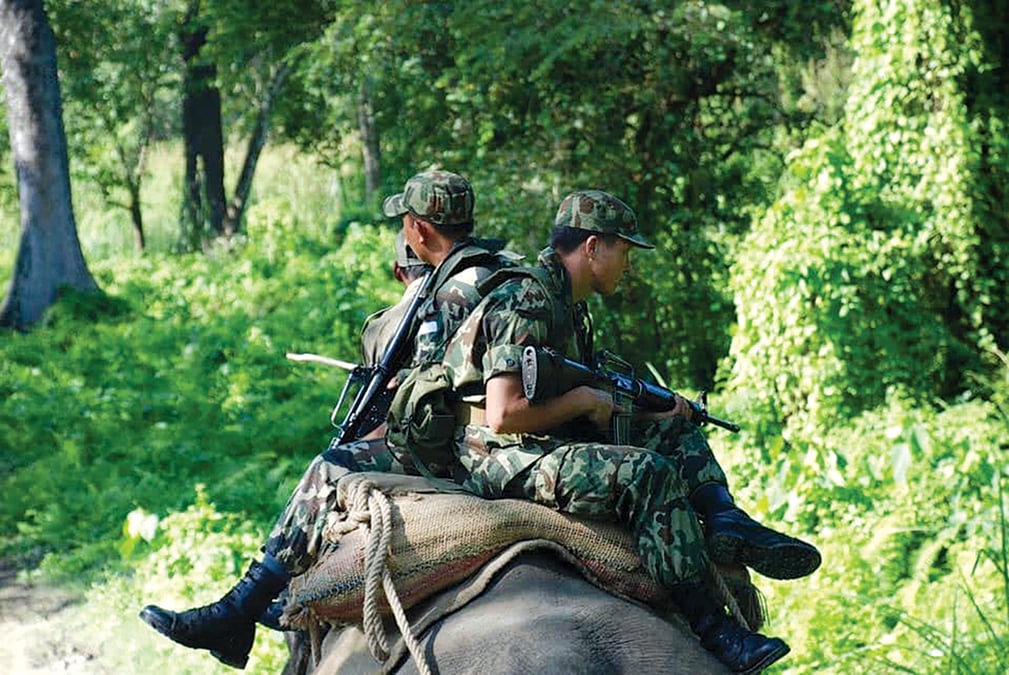
Nepal’s success in doubling its forest cover in 30 years has been possible for two reasons: community management of woodlands, and the protection of the country’s national parks by the Nepal Army.
But questions are now being raised about why national parks need to be guarded with guns when protection by local communities have been so successful.
“Our internal evaluation has shown that it is due to the presence of the military that endangered species have been successfully protected,” says Megh Nath Kafle of the Ministry of Forest’s Department of Biodiversity and Environment. “Without the army, conservation would have been much more difficult.”
However, some activists say giving all the credit for Nepal’s successes in conservation solely to the military would be a disservice to the scores of local communities that have been even more successful in protecting wildlife habitats.
Read Also: Protecting protected areas from infrastructure, Sonia Awale
“People living at the edge of national parks have played the most important role in nature conservation,” says Bharati Pathak of the Federation of Community Forest User Groups.
“By praising only the army, we ignore the contribution of local communities. The Annapurna Conservation Area is an example of successful conservation even without a military presence,” she adds.
The Nepal Army has also been accused of harassing local communities for entering buffer zone forests to collect wild edibles, or grazing livestock even though those areas outside the parks are not within the army’s jurisdiction.
Conservationists, however, say that the military's presence is critical in parks along the border with India to deter poachers. Killing tigers and rhinos for their pelts, bones and horns nearly decimated India’s wildlife in the 1980s and 1990s. Poaching increased in Nepal during the Maoist conflict when the army was redeployed elsewhere.
The Royal Nepal Army’s involvement in guarding national parks started in 1975 after Chitwan National Park was established, mainly to protect the seriously depleted numbers of rhinos and tigers.