
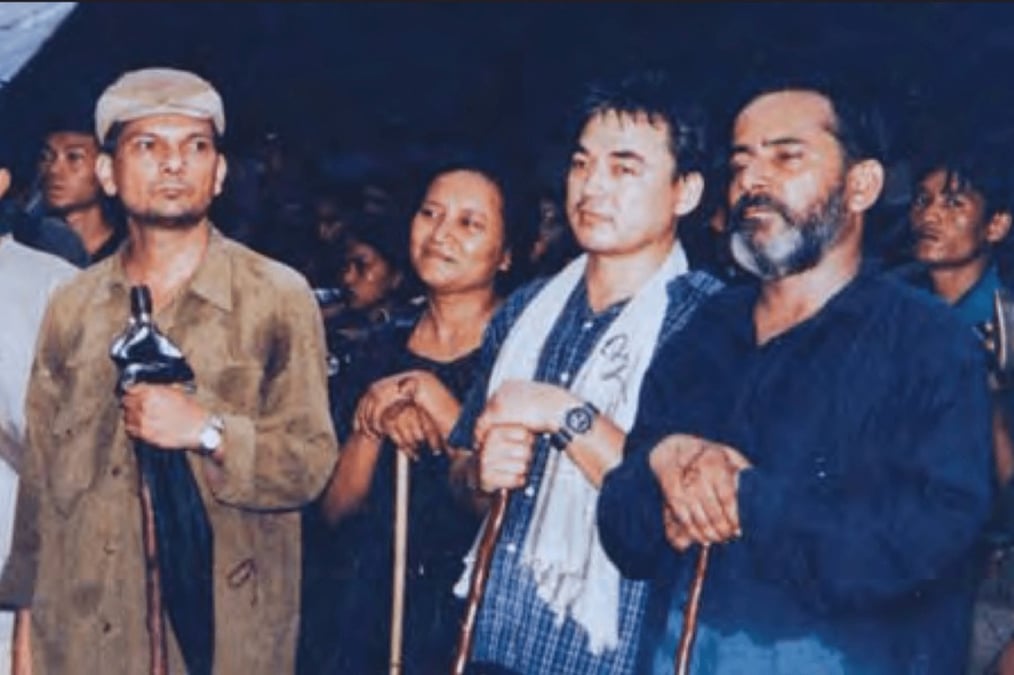
Besides being an election year in Nepal, 2026 is also the year of anniversaries. It is exactly 30 years since the Maoists launched their armed struggle on 13 February 1996, and it was on 27 April 2006 that the ceasefire came into effect after a month of massive pro-democracy protests.
Alas, three decades on, the decade-long conflict that claimed 17,000 lives has been air brushed from our history. For the survivors, and the families of those disappeared and killed, memories of loss and suffering are fading. The party that fought the war in Mao’s name has dropped it.
It is important on this day to remember not to forget that violent decade -- so that it does not happen again, and so the youth movement that has led to this election will also not be in vain.
The 8 September 2025 rally, the massacre that followed, and the nationwide mayhem and carnage the next day were largely a result of public anger boiling over. Nepalis had been let down repeatedly by rulers promising revolution in the name of the ‘people’: from the 1990 People’s Movement I, to the Maoist ‘People’s War’, and the 2006 People’s Movement II.
There are some positive residual effects of the insurgency. One-third of the Maoist militia was composed of women, this empowered not just the female guerrillas themselves, but indirectly made a whole generation of young women aware of their rights.
The peace process itself resulted in the Maoists entering the democratic mainstream, and the induction of many of the guerrillas into the national army – a rare occurrence after a conflict.
The ceasefire was followed by an interim government, and the first elected Constituent Assembly abolished the monarchy in 2008. Deadlock over the model of federalism meant a second election had to be held in 2013, and the new Constitution finally promulgated in 2015.
That statute was supposed to devolve political decision-making away from Kathmandu to autonomous provinces, improve inclusive representation of women and hitherto excluded castes and ethnicities at all three levels of government, ensure accountability and good governance to generate jobs and lift living standards.
There were seven governments in ten years after 2015, and tottering coalitions one after another failed to fulfil any of those provisions in the Constitution. There were subliminal gains in representation of women thanks to affirmative action, but as this election shows, women candidates are still used as proxies by patriarchal parties.
Since the two warring sides of the Maoist war both became the state, sharing power in dozens of coalition cabinets since 2006, they colluded to bury the transitional justice process.
The former supreme commander of the Maoists Pushpa Kamal Dahal (Prachanda) has become prime minister three times in the last 20 years. He is contesting this election from Rukum East, where he marked the 30th anniversary of the start of armed struggle on Friday.
The word ‘Maoist’ has been erased from the Nepali Communist Party which Dahal formed with more than a dozen other smaller leftist outfits. His main rival, Janardan Sharma, quit the Maoists and is standing for elections in Rukum West.
Both former comrades are competing for the hearts and minds of people of this former base area from where the Maoists went on warpath on 13 February 1996 by attacking a police station in Athbiskot, and simultaneously on targets in Holeri of Rolpa, Sindhuli and Gorkha.
The former ideologue of the Maoist party, Baburam Bhattarai, was the architect of the revolution while Dahal was the executor. Bhattarai submitted a list of 40 demands to the Sher Bahadur Deuba (during his first tenure as prime minister in 1995) but did not wait for a reply before launching the armed struggle.
The Maoists felt that the constitutional monarchy after 1990 was too feudal, and a patronage-driven parliamentary system too slow to bring about change. Besides, the democratic parties were accused of using state security to prevent Maoist candidates from winning elections.
The Maoists followed Mao’s Red Book to the letter, attacking police stations, looting weapons and targeting local elected governments, eliminating ‘class enemies' with summary executions.
They destroyed telecommunication towers, highways, bridges and airfields in remote areas. Threats forced health posts, schools, post offices to be withdrawn from areas where people needed them the most. The country’s development was pushed back decades.
Nepal in the early 1990s was ripe for revolution. There was inequality, social injustice, exclusion, and the political parties in Kathmandu were too busy squabbling to do their job. The Maoists wanted an end to the monarchy, but in 2001 the monarchy imploded with the royal massacre.
ABSOLUTE POWER
King Gyanendra succeeded his murdered brother to the throne, and took the country back to absolute rule with a military-backed coup in 2005. Within a year, street protests forced him to step aside. And by 2008, it was too late to save the monarchy.
We can look back as far as we want to the roots of the Maoist conflict. It can be blamed on elected leaders post-1990 who abandoned the people once in power, the 30 years of partyless Panchayat system that stifled dissent and let social pressures build up, or even 100 years of Rana rule.
It was the prolonged indifference on the part of successive rulers in Kathmandu that fed public discontent. These accumulated grievances were also the reason for the September 2025 events.
During China’s Cultural Revolution, Mao Zedong said: ‘The old has to be uprooted to be replaced with the new’, and that could almost be the anthem of the GenZ movement and this election.
The objective conditions that drove the Maoist insurgency 30 years ago are still evident today. And much will depend on the government(s) that will be formed after March.