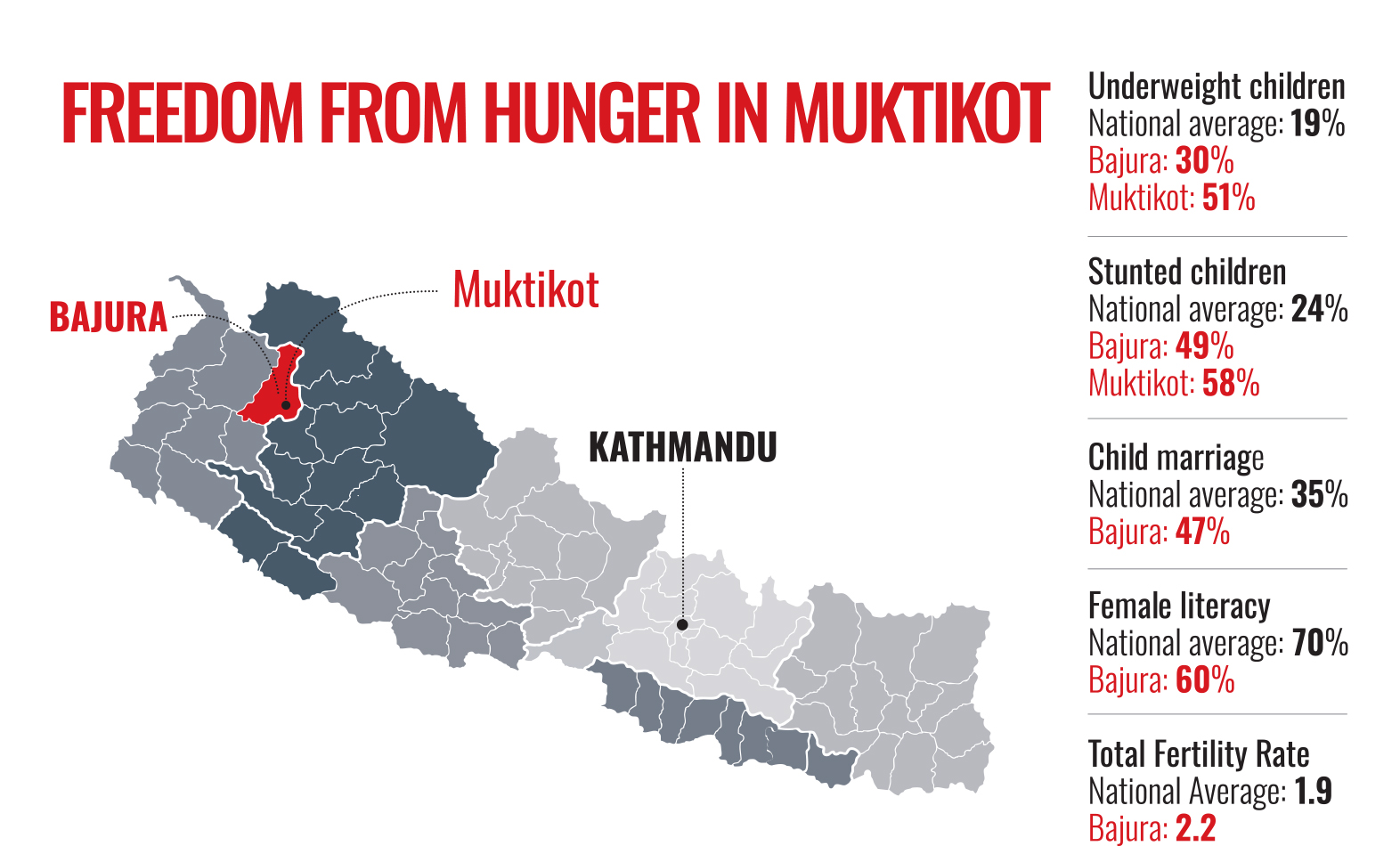
To understand the new wave of migration from the remote mountains of western Nepal, one just needs to look at the nutrition status of its children.
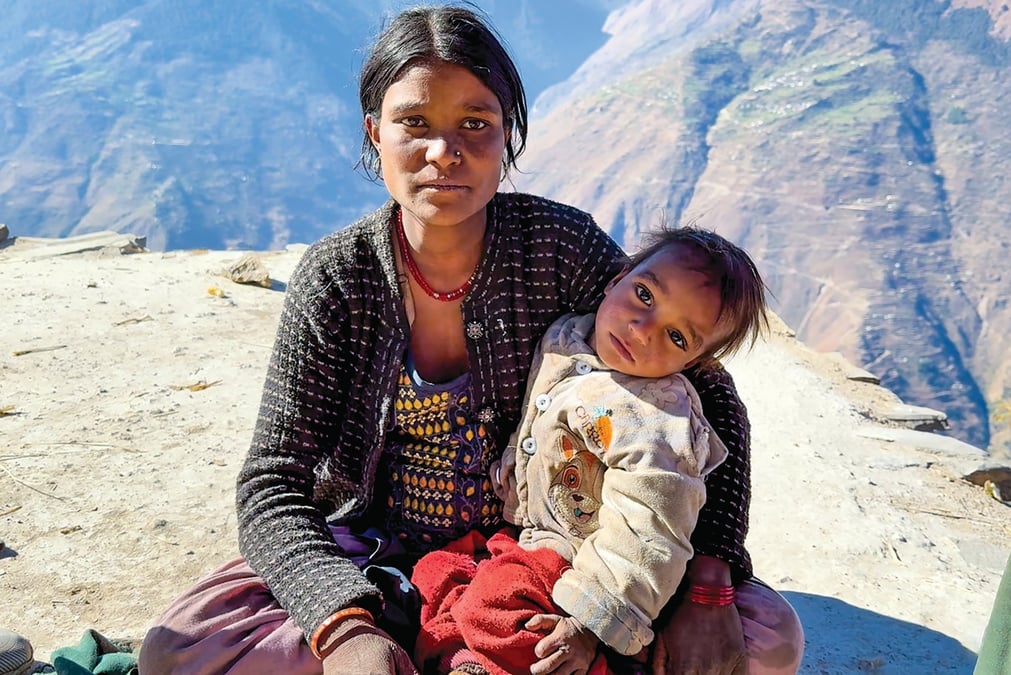
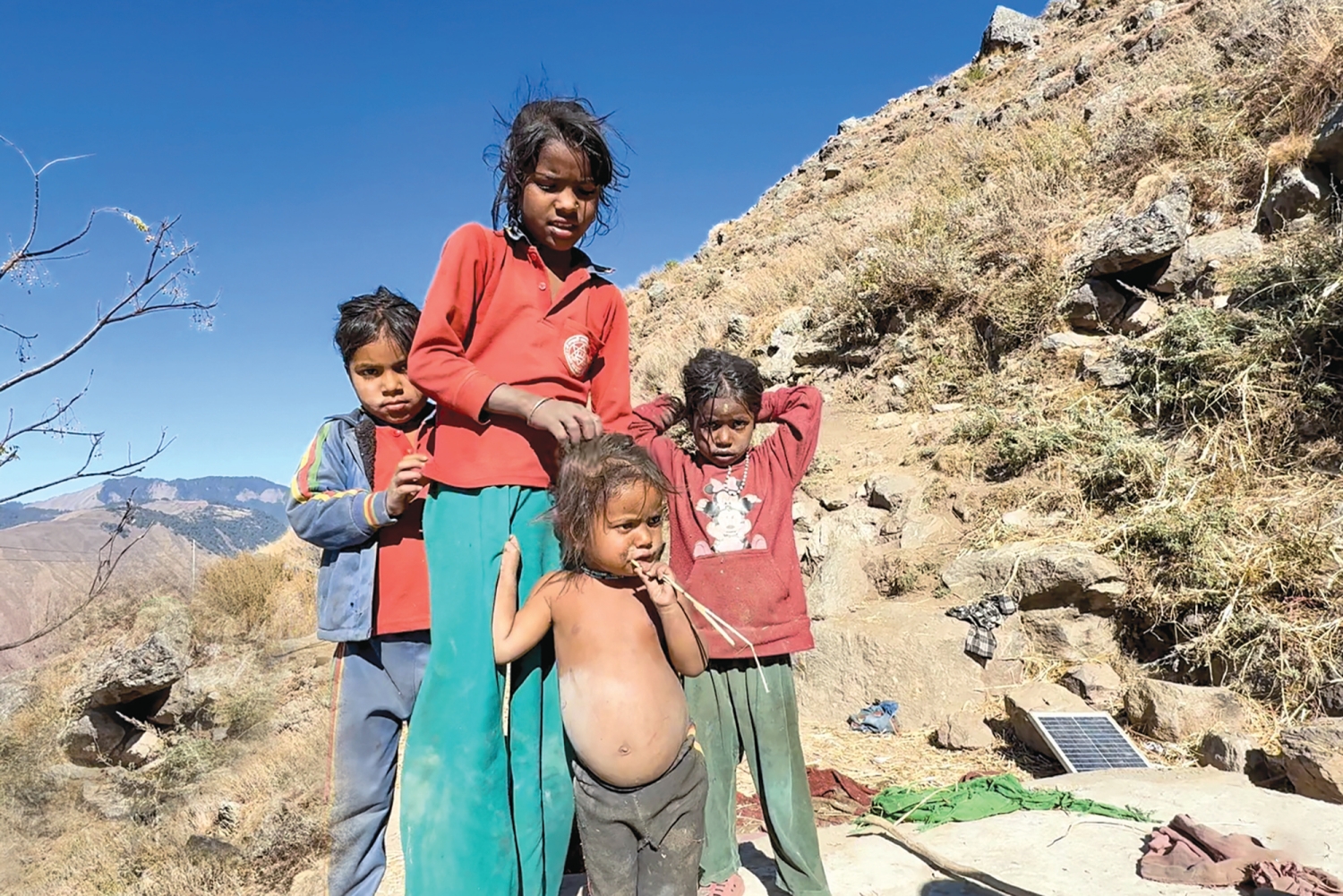
Hara BK’s 2-year-old son has an abnormally distended belly, his arms are thin — the result of insufficient food from fallow farms in this rugged and arid region of Nepal.
“Nothing grows here, I’m tired of walking to the health post,” the mother of two tells us, showing the nutrition packet the baby was given. “He gets better as long as we feed him the packet, then he is hungry again.”
Child marriage is still common in Bajura, and Hara was 15 herself when her parents married her off. By 16 she had her first baby. She is unable to produce enough milk for her baby, but already pregnant with a third child.
Nearly 90% of women in Bajura are malnourished. Says ward chair Ajay Kumar BK: “Children born to malnourished mothers also become malnourished.”
Geeta BK is 30. She has six girls aged 15, 12, 8, 6, 5 and 3, and a son who is 1. She tells us, “I had a baby every other year. There is no milk for this one.”
In remote districts like Bajura, child marriage, multiple births, unspaced birth all lead to malnutrition in mothers who then cannot provide enough nutrition for their babies.
“It is a vicious cycle of malnutrition and poverty,” says nutritionist Uma Koirala.
Hara and Gita’s husbands are seasonal migrant workers who go to Dehradun in India six months a year to work as labourers. During that time, the wives are doubly burdened.
Hazari BK, 23, of Muktikot village is severely undernourished, but has to raise a seven-year-old son and two-year-old daughter. She gave birth to her first child at 17, and two of her babies died young.
“This small girl is getting better but I could not breastfeed my son,” says Hazari, who is pregnant again.
NUTRITION PROGRAMS
The government has been implementing a ‘multi-sectoral nutrition plan’ in six districts including Bajura since 2013, involving education, agriculture, drinking water and sanitation, and local development ministries. The current phase of the program covering all local governments aims to reduce stunting to 15% by 2030.
A ‘Nutrition Assessment and Gap Analysis’ conducted in 2009 recommended that agriculture, education, local development and health should all play a role in addressing malnutrition.
Then in 2011, Nepal joined the global campaign ‘Scaling Up Nutrition’ (SUN) campaign, and a year later the government approved the multi-sectoral nutrition program which is still running with support from the European Union, UNICEF, the World Bank, the World Food Program, Canadian Aid, JICA, and the World Health Organization.