
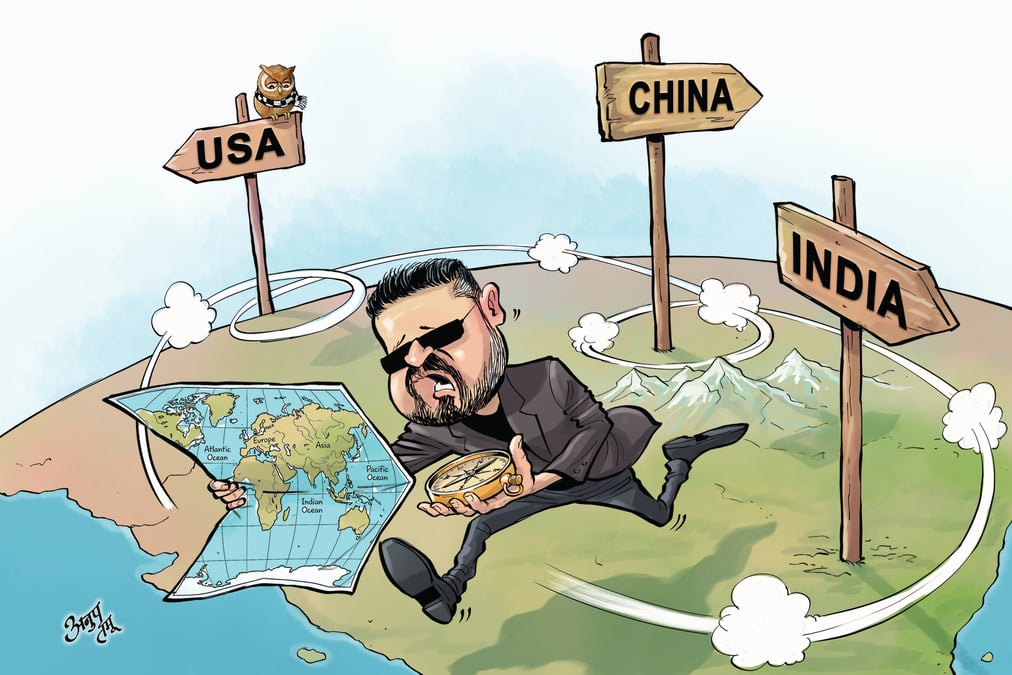
Global geopolitics is all topsy-turvy, the old order is falling apart and new strategic alliances are taking shape. And in Nepal, Prime Minister Balendra Shah must steer his ship of state through uncharted seas.
For five months since taking office, he has kept to himself — either due to a lack of confidence or as a deliberate paradigm shift in foreign policy intended to force Nepal’s giant neighbours and the international community to take it more seriously.
This has had the unintended consequence of aligning the interests of Beijing and New Delhi towards Kathmandu. Nepal watchers in both capitals have been scratching their heads trying to figure how to get a handle on what makes Prime Minister Shah tick.
American policy under President Trump had already brought about a Sino-Indian rapprochement of sorts, and there are suspicions in conspiracy-minded circles in Delhi and Beijing that what happened in Nepal last year was a US-inspired colour revolution in their backyard.
Whatever the truth, the message must have finally got through to advisers in the PMO that the prime minister’s opaque style of functioning was turning initial confusion in the international community about erratic behaviour into outright concern.
FUMBLES
A series of fumbles on the domestic front in handling communal violence in the Tarai, alleviating economic hardships, and growing dissent within his own RSP had already put Prime Minister Shah on the defensive — evidenced by his recent ‘I am all alone’ Facebook post.
Suddenly, the gates were flung open and the prime minister met individually for the first time with the Indian and Chinese ambassadors back-to-back this week. We’d have liked to be a fly on the wall at Singha Darbar, but all we have to go on are bland official statements about ‘taking bilateral relations to new heights’.
Even that is something. That we have to heave a sigh of relief when a Prime Minister of Nepal does something that is perfectly normal and within his terms of reference, is itself telling.
A possible visit by Indian Foreign Minister, S Jaishankar, to Kathmandu is on the cards to officially invite Prime Minister Shah to India on his first visit abroad. An Indian spokesman, however, refused to confirm this.
Chinese Ambassador Zhang Maoming, meanwhile, could have tried to gauge the nature of Nepal’s regime change and seek assurances that its perceived pro-West tilt will not harm Beijing’s concerns about Tibetan nationalists in a future Dalai Lama transition.
The Chinese have acted to stop what they see as the pro-Tibet antecedents of some RSP youth leaders, and in the past weeks have leaned on the Foreign Ministry to cancel an academic conference on Tibet at Kathmandu University.
“Kathmandu must transition from ‘equidistance’ to ‘strategic multi-alignment’ or ‘equiproximity’,” University of Hong Kong professor Brian Wong told Nepali Times in an interview. “When Beijing, New Delhi, or Washington come knocking, Nepal’s bureaucratic apparatus must possess the forensic ability to say: Here is what we accept, here are the conditionalities we reject, and here is how it optimises our sovereign interests.”
Nepal’s foreign policy at present is pulled in two opposite directions. On one side are Shah’s close advisers in the PMO, and on the other are career diplomats with Foreign Minister Shishir Khanal. The two power centres are still deadlocked this week over the appointment of 12 new ambassadors to key countries, including India, China, the US and UK.
RSP chair Rabi Lamichhane has been representing the government because of Prime Minister Shah’s aversion to direct diplomacy. He is set to visit Beijing later this month on invitation from Chinese leadership — his second after the June trip to India in which he got a rose petal welcome and an audience with Prime Minister Narendra Modi.
International relations has entered a post-ideological era in which pragmatism and balancing national interests guide policy. Nepal’s standing in the world will now depend on whether its ruling party and government understand this, and stop working at cross-purposes.
Note: The print version of this article contains incorrect information that Prime Minister Balendra Shah met with the American ambassador. This is a corrected version of the article.