
As Nepal prepares for the 12th National Population and Household Census, there is much happening behind the scenes before thousands of enumerators fan out across the country knocking door-to-door.
Scheduled for 8-22 June, this is the first census under a federal system and the most inclusive and ambitious since the first count was done in 1911.
Since the census happens once every 10 years, those involved are usually new and need extensive training. The Central Bureau of Statistics (CBS) has devised three levels of training at the central, provincial and local levels.
Three program sessions were completed as part of the central-level training in early March, during which 200 officials were brought up to speed to operate as provincial and district officers. They will be deployed in 87 census offices across Nepal. At present, CBS officials are on the last leg of a week-long, provincial-level training session for instructors countrywide.
The instructors will in turn train the enumerators and census supervisors, passing on skills on how to approach, interact with, and interview people and fill out the questionnaire.
To improve the process of data collection, CBS has also changed the method of collating information this time around. Instead of just assigning government school teachers for data collection as was the practice in the past, an open call for applications for enumerators and census supervisors was made.
“We had been having discussions for a long time about the need to mobilise educated young Nepalis around the country to help with data collection,” says Tirtha Raj Chaulagain, information officer at the CBS. “More than 120,000 people have responded to our request to apply, and there is bound to be a lot more applicants because there is still time until the application deadline.”
The CBS now faces the task of vetting applicants and selecting 39,000 enumerators and 8,000 census supervisors. Those who have completed high school are eligible to apply for ‘enumerator’ while those with a bachelor’s degree can apply to become ‘census supervisors’. The age limit caps off at 40 for male applicants and 45 for female applicants.
The data collection itself is set to be more comprehensive and detailed, with the use of three separate questionnaires.
How will Nepal develop in the next decade?, Sonia Awale
“Nepal will have the longest census questionnaire out of any other country in the world that conducts a census,” says Chaulagain. “Census questionnaires elsewhere in the world generally have 20 questions on average. Ours will have 55.”
The first pilot survey of House and Household Listing will be completed in May, which will collect household and livestock data. For gender identity, the option for ‘Other’ was introduced for the first time in the last census in 2011. Officials say they are preparing to note that survey provides space for individual conversations and safe space for gender minorities.
The second phase will begin after the responses of the first one has been analysed. This will allow time for the CBS to conduct an entirely different survey depending on the data that they receive.
The main questionnaire will have 55 questions related to family resources, property ownership and income. Other details related to language, religion, ethnic identity, educational background and disability will also be part of this section. The main questionnaire will have 8 questions related to head count of family members living and working overseas.
Two new parameters have been added to the main questionnaire, one being ancestral language, and another a question about whether children under 5 years of age in any given household have birth certificates or not.
The third part of the census will be the Community Questionnaire, the first of its kind used in a national census. Information from every ward in the country, ranging from the demographic structure of each community to its access to government services, development infrastructure, national resources, and disaster preparedness will go into this.
Among all the firsts happening this time, another one of them is the documentation of the existing infrastructure. Count of buildings, along with information indicating their use and purpose is a part of the questionnaire. There are questions that will help differentiate between villages and cities, eventually contributing to mapping the degree of urbanisation of each ward.
The census will also make a more prominent use of technology in the data collection process this time around. Enumerators deployed within Kathmandu Valley will use electronic tablets to collect data, while paper-based questionnaires will be used in the rest of the country. Nepal’s diplomatic missions around the world will participate in an e-census by responding online.
Scholars and population experts note that this year’s census is going to be the most inclusive and accurate census in Nepal’s history.
Lies, damned lies, and statistics, Ramesh Kumar
“Not only are the questionnaires themselves more inclusive of Nepal’s diverse communities, but the operational modality itself has changed. The members of civil society and other concerned organisations will be able to directly participate in the data collection process,” says Yogendra B Gurung, PhD, who teaches at the Tribhuvan University.
CBS has also adopted the motto, ‘My Census, My Participation’, to reflect the level of interaction this census is expected to engage the citizens in.
“Potential enumerators and supervisors will be selected based on which communities they belong to and what languages they speak because that makes a big difference in their ability to interact with a diverse range of people across different communities,” explains Tirtha Raj Chaulagain.
The census results are expected to reflect the country’s changing socio-political and demographic landscape more accurately. The study is expected tol provide more accurate data on the increasing urban-rural divide.
“All levels of our government and our civil society have felt the need and are waiting for new data, as old data and statistics are outdated and of little use under the federal system,” says Gurung. “With the data collection parameters becoming so comprehensive, there can be no doubt about the quality of the results, provided that the data is managed in an efficient manner.”
Nepal’s population to cross 30 million, Nepali Times
_________________
A century of census
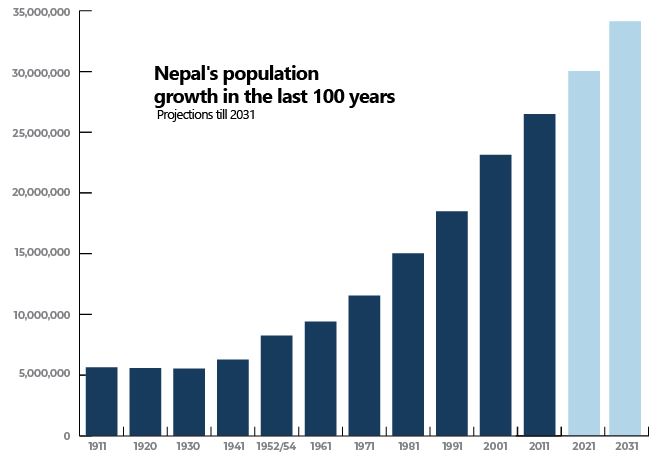
Although official accounts document the first Nepal census in 1911, there have been claims and accounts of Jang Bahadur Rana conducting a headcount after returning from the UK in 1850.
In fact, Volume 1 of the 2014 Population Monograph of Nepal published by the National Planning Commission and the Central Bureau of Statistics mentions head-counts, counting households, stone taps, paatis, and temples at various points in history before and during the prime ministership of Bhimsen Thapa from 1806 to 1837.